

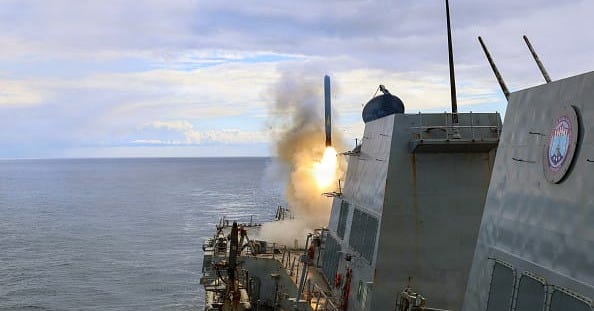
New Tomahawk variants with radar-absorbing stealth coating, and another with forward-canted wings, have been seen in use.
America has been expending Tomahawks at a faster rate than production for years now.
Interceptors may be depleted quickly at high tempo: Army interceptors in ten days, Navy interceptors in two weeks.
Use of these munitions makes U.S. willingness to sell Patriots to Europe less likely.
The expenditure of these munitions may mean that American power is diminished for a potential conflict with China over Taiwan.
The second round of the U.S.-Israeli attacks on Iran have been devastating for Iran and essentially bloodless for the Americans and their allies—so far.
But the strike campaign isn’t without risk. President Donald Trump’s administration is expending a significant proportion of America’s best firepower—at a speed that may take the country’s industrial base years to replenish and leave American power diminished for other wartime scenarios.
Rebuilding that firepower could prove time-consuming and expensive, with serious implications for the war in Ukraine, and a potential conflict with China over Taiwan.
U.S. strikes on Iran have involved America’s best munitions, including some types that were unknown before now, such as new variants of the Tomahawk cruise missile. It took years and billions of dollars for the U.S. Defense Department to stockpile these munitions. It now risks depleting them in a matter of weeks.
European powers should take heed. As dire as America’s munitions problem is, Europe’s own missile stockpiles are far smaller—and its capacity to wage high-tech war is even more limited.
Low-flying, subsonic cruise missiles apparently accounted for most of the munitions in the initial wave of U.S. strikes on Iran on Feb. 27 and 28. There’s imagery confirming the U.S. Navy fired Tomahawk cruise missiles from some of the roughly 12 destroyers and four attack submarines it has sent to the Middle East alongside the centerpieces of its deployed fleet: a pair of aircraft carriers.
The same imagery hints at potentially two new Tomahawk variants: one with what appears to be a radar-absorbing stealth coating and another with forward-canted wings, possibly for improved stealth.
The size of the U.S. Tomahawk inventory is a closely held secret, but it’s safe to assume it’s measured in the thousands. How many of the Raytheon-made Tomahawks the Americans fired in the first 24 hours in the current conflict is unclear, but the Pentagon has stated it targeted hundreds of facilities.
The problem is that, for years now, successive U.S. administrations have bought fewer of the $2.5-million Tomahawks than they’ve used every year, meaning the inventory has steadily declined.
Help Get Us To 600 Paid Subscriptions!

Help Trench Art reach its next major goal: 600 paid subscribers. Take 20% off an annual sub—and know that you helped keep this site going through 2026.Trench Art is a reader-supported publication. To receive new posts and support my work, consider becoming a free or paid subscriber.
Look up OA-1K.
Operation Epstein Forgetaboutit Fury will still not take the stink from the rapes of girls and women.