

There were growing signs, before the current ceasefire, that U.S. Pres. Donald Trump was considering capturing the oil terminals on an island critical to Iran’s energy infrastructure.
“Maybe we take Kharg Island, maybe we don’t,” Trump told The Financial Times last week. “We have a lot of options.”
Either operation may require an amphibious landing by U.S. Marines or other military service members. It should come as no surprise, then, that the Pentagon is massing thousands in the Persian Gulf aboard six assault ships organized in two amphibious ready groups.
Any amphibious operation would be extremely risky as lumbering and lightly armed ships disgorge slow, vulnerable landing craft packed with Marines and their equipment—and the landing craft slowly motor toward potentially heavily defended beaches, possibly while under attack from below, on and above the waves.
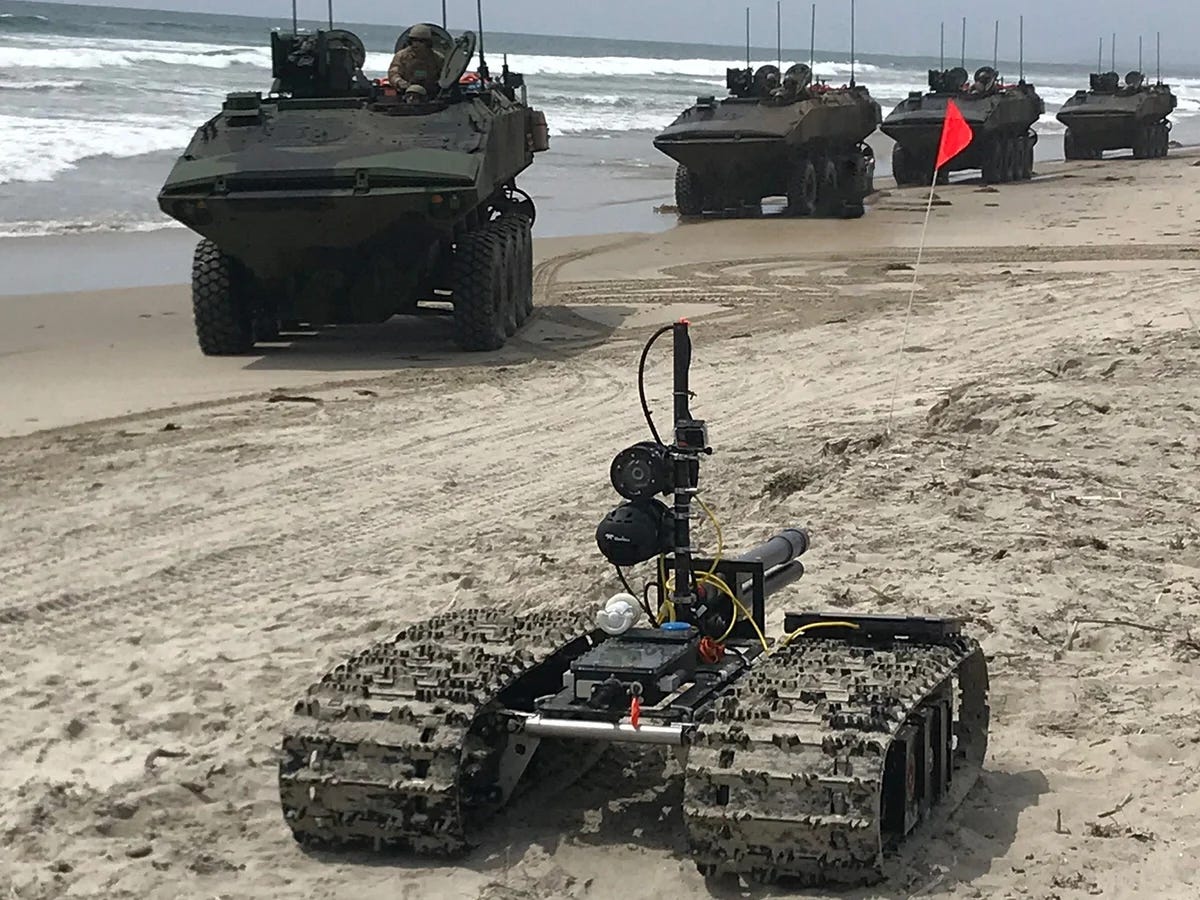
Drones can help build up combat power while reducing risk for those executing the operation.
Unmanned systems “can provide [surveillance] and initial strike capability against whatever targets and enemy defenses may already be in place to meet the amphibious assault,” said Samuel Bendett, a drone expert with CNA, a Virginia think-tank.
Even successful U.S. amphibious landings during World War II, the last conflict where they were common, usually left thousands of Americans dead or wounded.
An array of defense companies are working hard to make amphibious ops less risky for the landing force, by replacing some of the people with autonomous or remotely-controlled machines.
Some of the systems are already in use in the U.S. Marine Corps. Some are coming soon.
All represent an effort to staunch the bloodletting traditionally associated with beach landings under fire.
Low-profile vessels
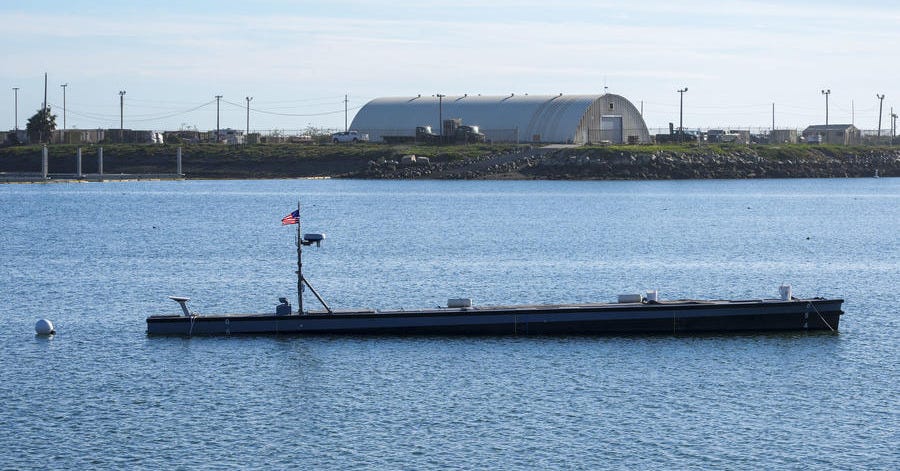
Virginia-based Leidos has developed an unmanned surface vessel—basically, a self-steering motor boat—that could stealthily scout enemy waters ahead of an amphibious landing, and then help resupply the landing force after the force gets its feet dry. Leidos’ Sea Specter is a so-called “low-profile vessel.” That is, a boat that sits very low in the water, just a foot or so of it rising above the surface.
Leidos declined to comment on the Sea Specter.
Low-profile vessels are extremely difficult to detect, which is why drug smugglers favor them… and why the Marine Corps has acquired three of the 65-foot Sea Specters for testing and is mulling a follow-on order for hundreds of operational examples for around $150,000 a copy.
Motoring hundreds of miles at a top speed of 11.5 miles per hour, five tons of cargo in their holds, the unmanned boats—likely satellite-guided but with a possible magnetic navigation backup—could reduce the risks before and after a landing, by removing the human crews from amphibious scout and resupply missions.
Seems of little use against drones, especially if there is an ISR at altitude and dozens of attack drones.
Also no point in taking Kharg Island. Only a few ks from shore-based artillery; difficult to resupply; Iran can use land based pipelines; Russians and Chinese naval escorts would involve open warfare with those countries. Notice UK’s Royal Navy did nothing when Russia escorted tanker thru the Channel this week.
We know Hegesth is not very bright. Looks like USNA spends too much time on engineering courses and not on standing up to gross stupidity.