

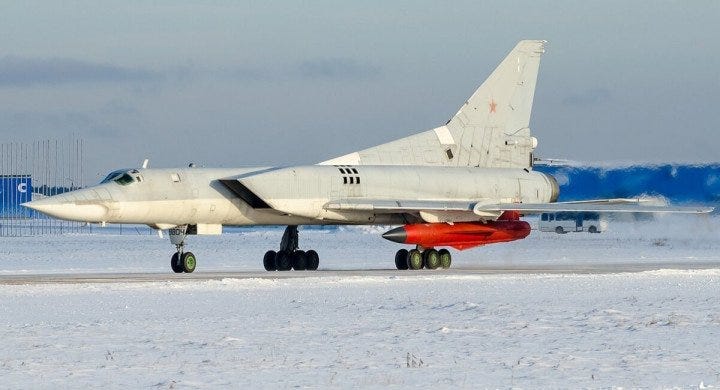
The Russian air force’s Tupolev Tu-22M3 Backfire bombers had been mostly idle for a long time. But that has changed—and now modernized Tu-22M3s are firing six-ton Kh-32 anti-ship missiles at Ukrainian cities and power plants.
The bombers and missiles pose a new threat to Ukraine as the winter deepens and Ukrainian air defenses struggle to defeat increasingly powerful Russian air raids. The raids have devastated Ukraine’s power grid and cast much of the country into darkness as the temperature plummets below zero degrees Fahrenheit.
On Jan. 24, Russian bombers, warships and air-defense batteries bombarded Ukraine with Zircon and Iskander ballistic missiles, missiles from S-400 surface-to-air missiles batteries and—for the first time in months—Kh-32s. At least a dozen of them.
The main target was Kyiv. One person died and eight were wounded. In the aftermath of the overnight attack, 1.2 million properties across Ukraine were without power.
The Kh-32, which the Soviet Union developed in the 1980s specifically for sinking U.S. Navy aircraft carriers, is a dangerous addition to the usual mix of Russian munitions.
“Although the Kh-32 is classified as a cruise missile, it flies at extremely high speed on a near-ballistic trajectory,” the pro-Ukraine Conflict Intelligence Team noted, “making effective interception possible only by SAMP-T systems and Patriot batteries equipped with PAC-3 interceptors.”
