

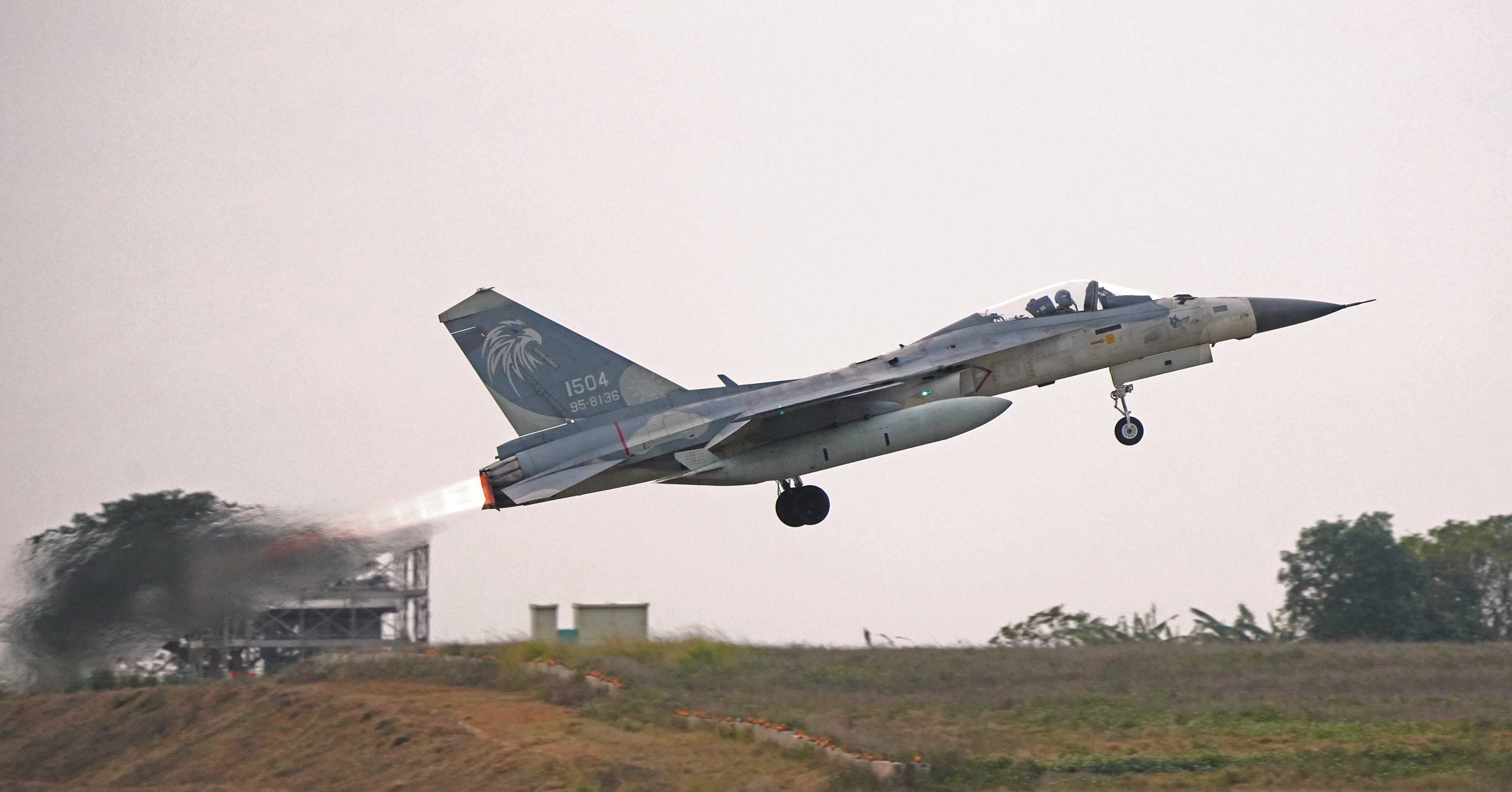
The Republic of China Air Force might survive just a few hours as a viable fighting force if and when autocratic China finally makes good on decades of threats and launches a full-scale invasion of democratic Taiwan.
But that doesn’t mean Taiwan can’t defend itself from the air—and buy time for a possible American intervention. An intervention that itself would be primarily aerial, and could go down in history as the most intensive anti-ship campaign ever waged.
Analysts anticipate that the PLA Rocket Force would initiate an invasion with a devastating barrage of ballistic and cruise missiles, after which the PLA Air Force would take to the air for a sustained period of precision bombardment.
“Based on PLA studies that appear to be indicative of doctrine, the PLA will seek to gain rapid mastery of the air before conducting amphibious operations across the Taiwan Strait,” explained Ian Easton, a professor at the U.S. Naval War College in Rhode Island.
The ROCAF’s 11 major air bases—housing the service’s roughly 600 aircraft including around 350 AIDC F-CK-1, Dassault Mirage 2000 and Lockheed Martin F-16 fighters—would be top targets. “A sudden, coordinated missile attack on all of Taiwan’s airports and air bases is possible and would play to the PLA’s strengths,” Easton said.
Those strengths include an arsenal of several thousand ballistic and cruise missiles and no fewer than 2,000 tactical aircraft. Chinese missiles and bombs could crater runways, flatten hardened aircraft shelters, smash the entrances to underground hangars and, of course, destroy any Taiwanese aircraft that get caught on the ground and out in the open.
Taiwanese squadrons could disintegrate fast. “If the ROCAF were present at its bases when the PLA launched a large-scale assault on the island, I would estimate that its combat effectiveness might be measured in minutes to hours,” said Thomas Shugart, a retired U.S. Navy captain who now heads Archer Strategic Consulting in Virginia.
For the Taiwanese, going underground might be the smartest strategy. “By increasing the number of fighters routinely kept inside tunnels, it seems likely that Taiwan could maintain a fleet-in-being until Zero Day,” the day the amphibious fleet hits the beaches, Shugart said.
The only other survival strategy might involve whole squadrons retreating from Taiwan. “Were Taiwan to evacuate the ROCAF in the event of an impending attack—if it had sufficient warning—I could see it fighting on as a force in exile from more dispersed bases elsewhere, possibly in conjunction with U.S. and partner air forces,” Shugart said. “In that case, it could live to fight another day.”
