

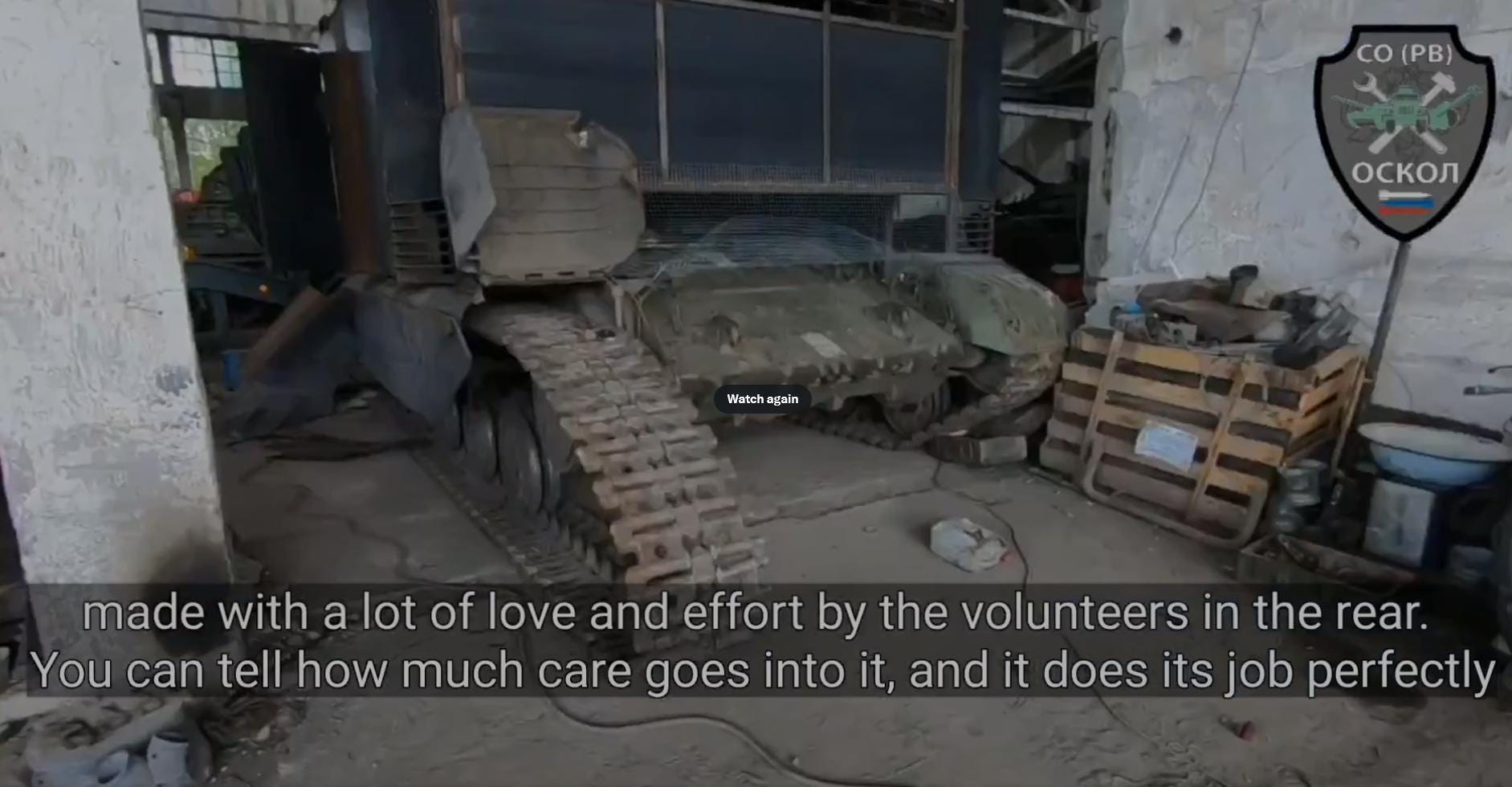
Russian turtle tanks are common
But Russian turtle tanks based on the Ukrainian T-64 are uncommon
So where did this one Russian T-64 turtle come from?
A Russian repair unit has transformed at least one T-64 tank into a drone-proof “turtle tank.” Up-armored turtle tanks with their metal shells and other additions are commonplace all along the 1,100-km front line of Russia’s 47-month wider war on Ukraine.
Up-armored turtle tanks based on T-64s aren’t commonplace, however.
So where did this particular turtle come from? And does its appearance signal a wider acceptance of a tank type the Russians have neglected for years despite heavy losses of other types?
The T-64 turtle appeared in a video that circulated online this week. In the video, a member of the Oskol Repair Unit extols the virtue of the 42-ton tank that forms the basis of the do-it-yourself assault vehicle.
The mechanic points out the three-cylinder, six-piston diesel engine—a unique feature of the T-64. “Each cylinder has two pistons moving directly opposite each other,” he explains. “It’s one of those clever engineering solutions created by our Soviet designers.”
In fact, the T-64 is a Ukrainian tank, designed by the Morozov Design Bureau and built by the Malyshev Factory—both in Kharkiv in northeastern Ukraine. The Soviet army adopted the T-64 in the 1970s but quickly pivoted to simpler tanks, including the T-72, T-80, and variants.
Russian turtle tanks, mostly based on the abundant T-72s, first appeared in Ukraine in 2023. They now fill a special operational niche that exposes them to extreme danger. Piled high with anti-drone defenses, they tend to lead columns of less-well-protected infantry fighting vehicles or other infantry transports.
During vehicular assaults—which, to be fair, became much rarer last year—the turtles clear mines and absorb impacts from Ukrainian drones, preserving the trailing vehicles and their precious infantry passengers.
A turtle may not survive the repeated blasts, but it doesn’t have to. Its purpose is to shepherd the infantry to new positions, even at the cost of itself.
Read the rest at Euromaidan Press.
New Subscription Prices For 2026

Happy 2026! We’re keeping prices low for annual, monthly, group and gift subscriptions. Subscribe now for daily war new and analysis—and keep Trench Art thriving for another year.