

by STEVE WEINTZ
The Cold War was full of crazy ideas. No nuclear weapon was too big. No munition was too small. They were even used as warheads for anti-aircraft missiles.
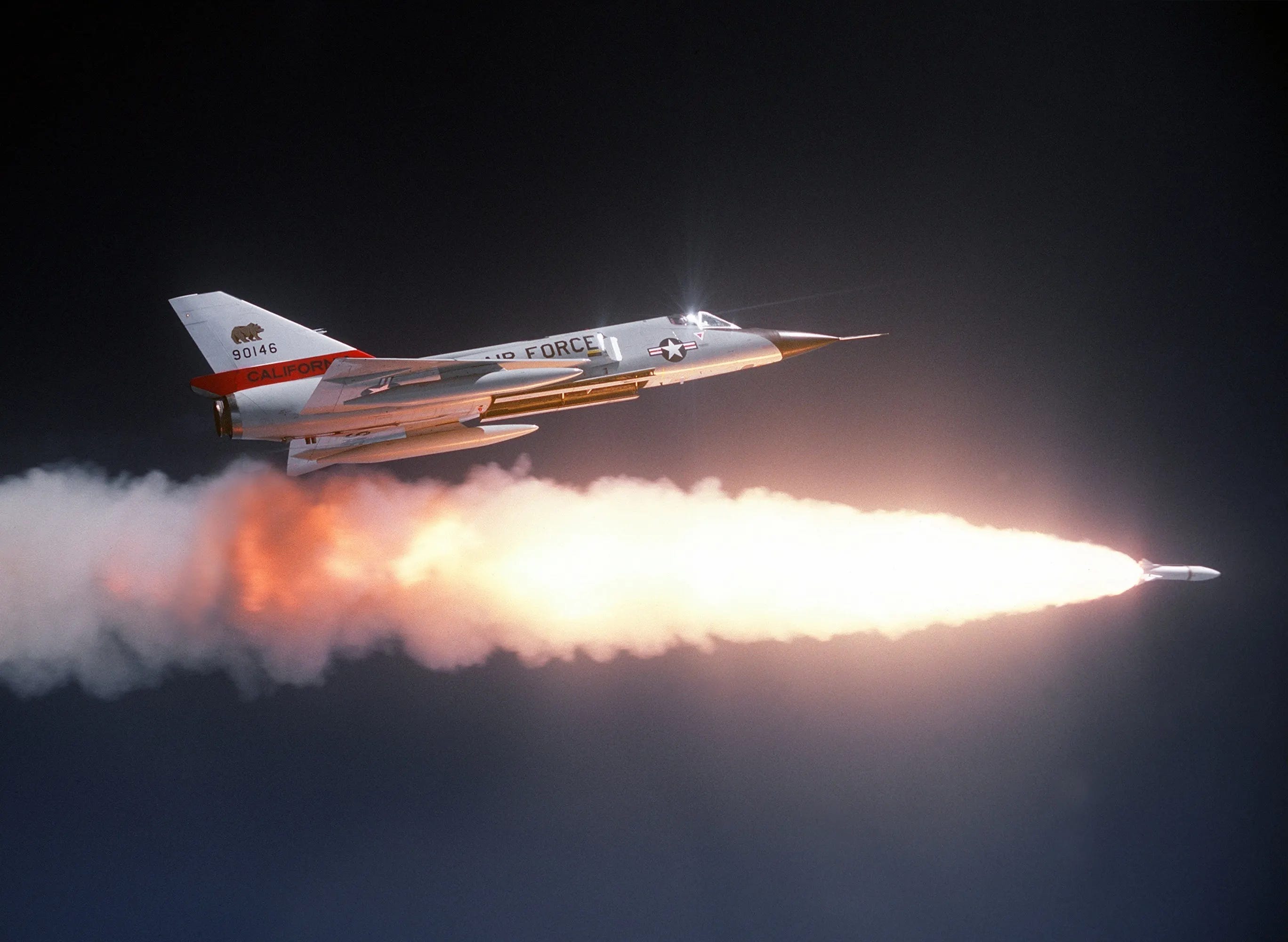
Beginning in the 1950s, the U.S. Air Force developed nuclear anti-air missiles that would be built by the thousands. The result—the MB-1/AIR-2 Genie—was the most powerful air-to-air missile ever made in America.
Less than 10 feet long, 18 inches in diameter and only 900 pounds in weight, the Genie—also called the “Ding-Dong,” a tag probably derived from its rather phallic appearance—was a stubby, plump rocket. The Genie’s bulging tip held one of the smallest atomic bombs produced at that point: the W-25.
At the time, one of the most serious national security concerns for the United States was the threat of an attack by nuclear-armed Soviet bombers. In 1955, a blue-ribbon panel chaired by MIT president James Killian concluded that only nuclear anti-aircraft weapons could counter the high-flying bombers—and recommended immediate development.
The main reason was that old-school machine guns and cannons were no match for high-flying bombers lumbering over the North Pole at 500 miles per hour. The Air Force wanted the Genie.
In a coincidence, Walt Disney was about to produce the television program Our Friend the Atom, all about the benefits of nuclear technology. In the program, the atom is presented in the form of a mighty djinn.
Since the warheads would explode at high altitudes, it was assumed the blasts would pose no danger to civilians. “[T]he radioactivity which would be added to the atmosphere by the use of the warheads,” stated the panelists, “is of no consequence at all.”
Douglas Aircraft had already begun designing a new air-to-air missile for the Air Force’s Northrop F-89, McDonnell F-101 and Convair F-106 interceptors. To power the missile, contractors Aerojet and Thiokol created short, thick solid-rocket motors packing nearly 18 tons of thrust.
Los Alamos National Laboratory, already shrinking the size and weight of nuclear weapons for the burgeoning ICBM program, came up with a nuclear warhead small enough to fit.
