

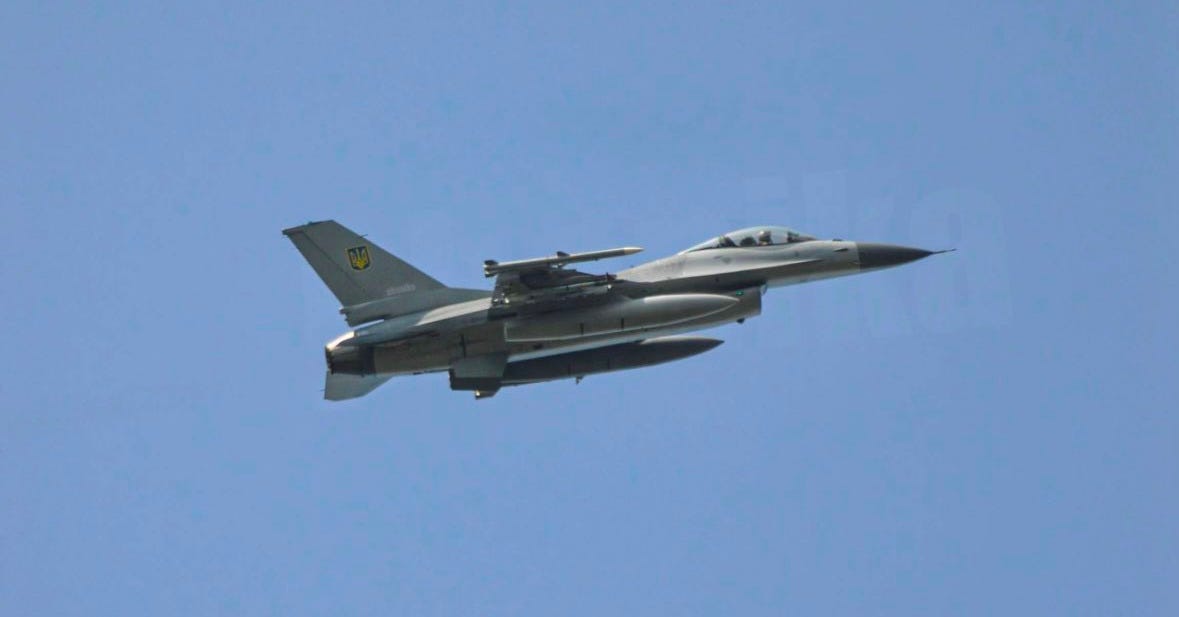
Gradually swapping its weary ex-Soviet fighters and bombers for somewhat less exhausted—and more sophisticated—Western fighters, the Ukrainian air force has radically transformed in the last two year.
But the fighter inventory isn’t the air force’s biggest worry. No, its most urgent problem right now is a desperate shortage of long-range surface-to-air missiles with anti-ballistic capability. And that problem probably doesn’t have a mostly Western solution.
“Western fighters now form the core of the Ukrainian Air Force in the shape of the 107th Wing, equipped with F-16, and a smaller force of Mirage 2000-5s,” Justin Bronk, an analyst with the Royal United Services Institute in London, announced in a recent commentary.
Just how many ex-Danish, ex-Dutch and ex-Norwegian Lockheed Martin F-16s and ex-French Dassault Mirage 2000s are in Ukrainian service is a closely held secret: but it’s likely there are around 50 of the former and fewer than a dozen of the latter.
Given that the air force has assigned its F-16s to the new 107th Wing, it still needs scores of Sukhoi Su-24s, Sukhoi Su-25s, Sukhoi Su-27s and Mikoyan MiG-29s to sustain its pre-war force structure.
After more than four years of wider war, scores of airframe losses and a lot of wear and tear on surviving aircraft, there are probably still a dozen each Su-24s and Su-25s as well as a couple dozen each Su-27s and MiG-29s in the active inventory.
Overall, the air force probably still has more than 100 active tactical aircraft. Around half are Western types.
There are fewer and fewer things the ex-Soviet jets can do that the F-16s and Mirage 2000s can’t do—and better. The F-16 and Mirage 2000 both have better sensors than the Soviet types have. Arguably more importantly, the Western jets have radar jamming gear, which the Soviet types lack.
