

by DAVID AXE
Armored vehicles aren’t dead in Ukraine—they just need a lot of help. That’s one of the biggest lessons from the Ukrainian 3rd Army Corps’ Operation Vivaldi, its recent successful counteroffensive just north of the town of Lyman in eastern Ukraine’s Donetsk Oblast.
Defying critics who insisted vehicles couldn’t possibly survive in the drone-patrolled gray zone, the 3rd Army Corps repeatedly deployed mechanized forces as it counterattacked across a roughly 100 sq km salient the Russian 20th and 25th Combined Arms Armies had extended toward Sloviansk, one of the last two big free cities in Donetsk Oblast.
Maneuvering for months under a veil of secrecy, the 3rd Army Corps found and exploited gaps along the flanks of the 20th and 25th CAAs, ultimately breaking into the Russian armies’ rears and forcing them to pull back across the Zherebets River in order to avoid encirclement.
Armored vehicles were key to the Ukrainian effort. They sped assault troops into battle, dropped them off under fire, and then supported them as they clashed with the Russians. “Maneuver warfare isn’t going anywhere,” stated Ryan O’Leary, a US Army veteran who once commanded volunteers in Ukraine.
3rd Army Corps commanders knew they were taking a risk deploying armored vehicles in a Russian-controlled salient patrolled by first-person-view drones from Russia’s elite Rubicon Center drone unit. But they clearly believed that, with adequate support, the vehicles could accomplish their missions—and survive.
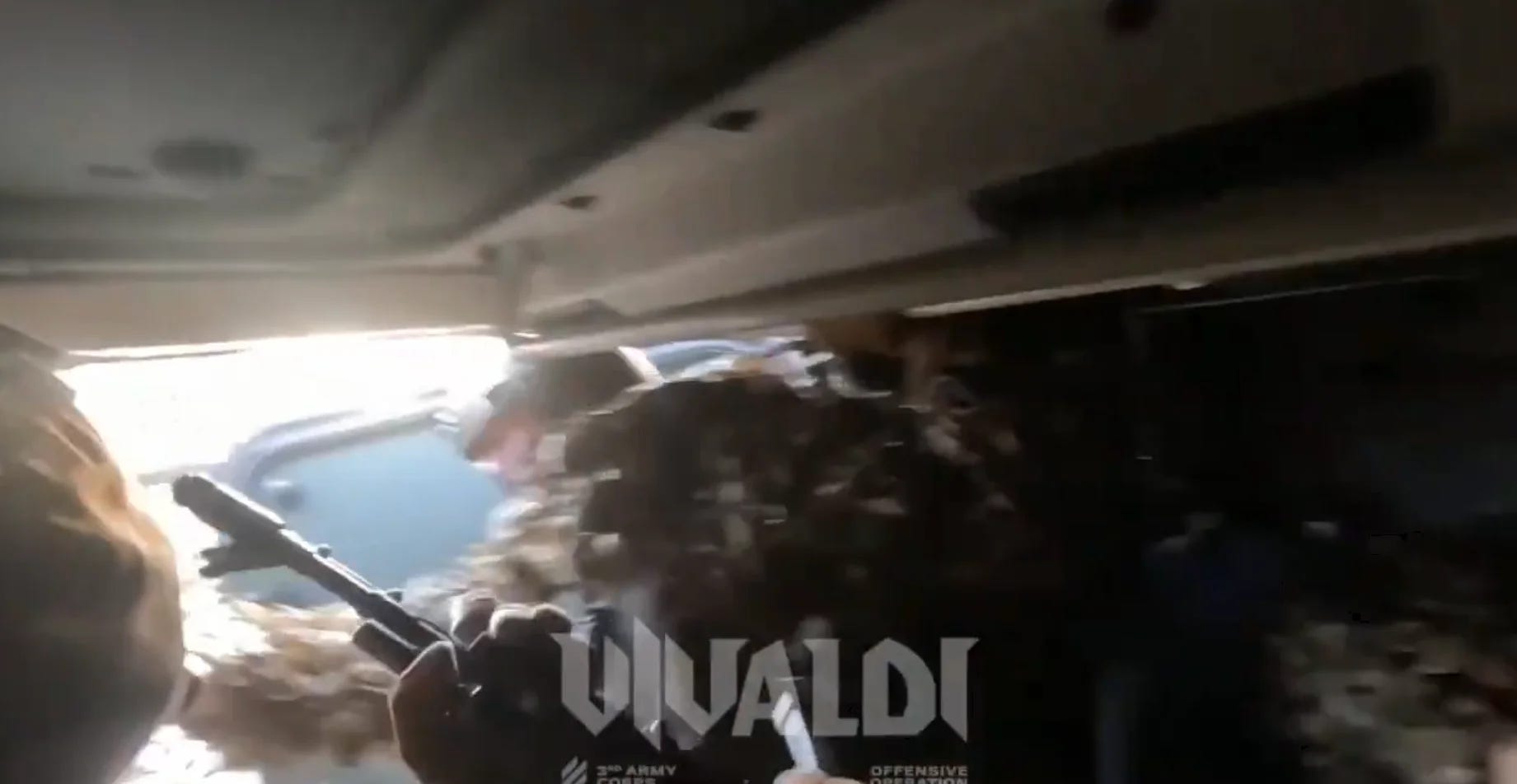
They were right. A dramatic video shot by 3rd Army Corps troopers depicts the troopers disembarking from their armored trucks and rushing into the fight while small arms fire clatters all around them.
Given the intensity of the Russian fire, a mechanized assault “was the only real way to push positions in an effective manner to keep losses low as well as gain and hold momentum and aggression,” O’Leary wrote. Walking into battle under the cover of trees might help the infantry avoid the attention of overhead drones, but it takes too long to sustain an aggressive assault, and it can be difficult to mass enough footborne infantry to overcome stiff enemy defenses.
“This is something that hasn’t changed even with the advent of drone warfare coming of age,” O’Leary added. “Suppression tactics and such have changed and now there is more than just indirect fires and counterassaults that you must be able to suppress and plan for.”
But the concept of the infantry-carrying armored vehicle “isn’t going anywhere,” O’Leary stressed. “Especially when it takes a drone tens of minutes to get to target area, acquire target and hit the target. Right now, the front is extremely susceptible to maneuvering forces on assaults if it is planned right and executed properly.”
The 3rd Army Corps’ Operation Vivaldi is an excellent example of an operation that was planned right and executed properly—in ways that helped the corps’ mechanized forces fight and survive.
Read the rest at Euromaidan Press.
20% Off Paid Subscriptions!

Help keep Trench Art going by taking 20% off a paid subscription! That’s just $36 a year for daily war news and analysis.Trench Art is a reader-supported publication. To receive new posts and support my work, consider becoming a free or paid subscriber.