

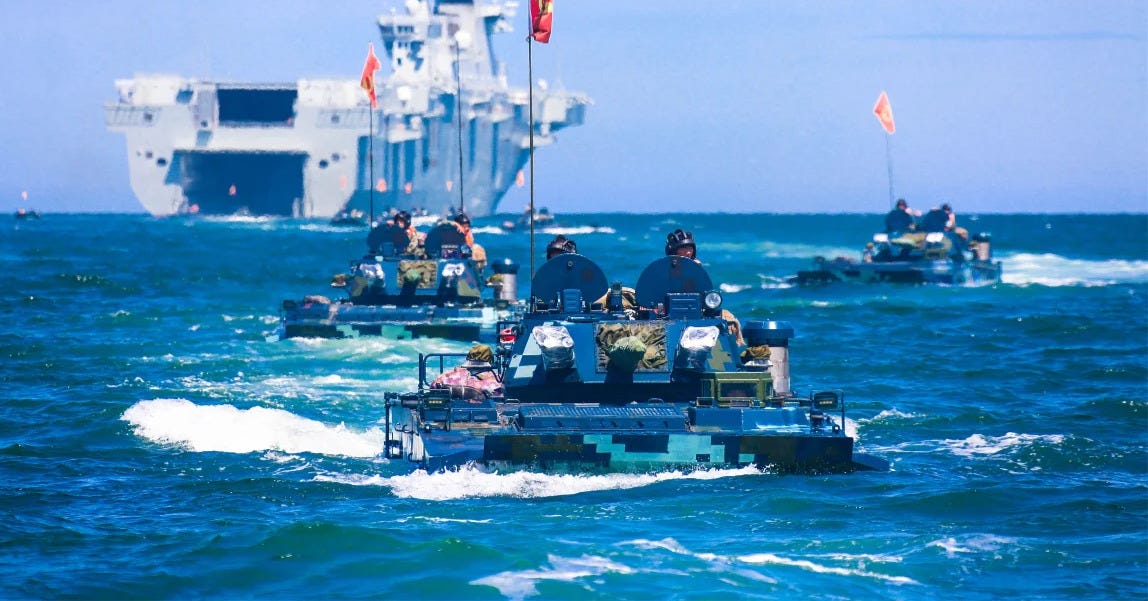
The conventional wisdom is that, if and when China makes good on decades of threats and invades Taiwan, the attack will be so big and so complex that everyone will see it coming. Ships will slowly gather in ports. Piers will groan with growing heaps of supplies. Troops will crowd into barracks—and wait.
The assumption is that all of this preparation will be visible on satellite for weeks in advance of H-hour. Intelligence agencies would overhear intensifying chatter among PLA planners scrambling to organize the invasion.
That isn’t to say that, under the conventional wisdom, the ensuing assault would be easy to defeat. It’s one thing to detect a Chinese invasion fleet numbering potentially thousands of ships and carrying as many as a million troops. It’s another thing to sink that fleet—or enough of it, at least—before it crosses the 100-mile Taiwan Strait.
But Taiwan and its allies may not even have the benefit of that advance notice they’ve long taken for granted, warned Ian Easton, an associate professor at the U.S. Naval War College’s China Maritime Studies Institute. “I used to think surprise attacks were a thing of the past,” Easton said.
“Taiwan, in particular, seemed to have little to fear of a sudden invasion,” Easton added. “Then I did some more research. It changed my mind.”
