

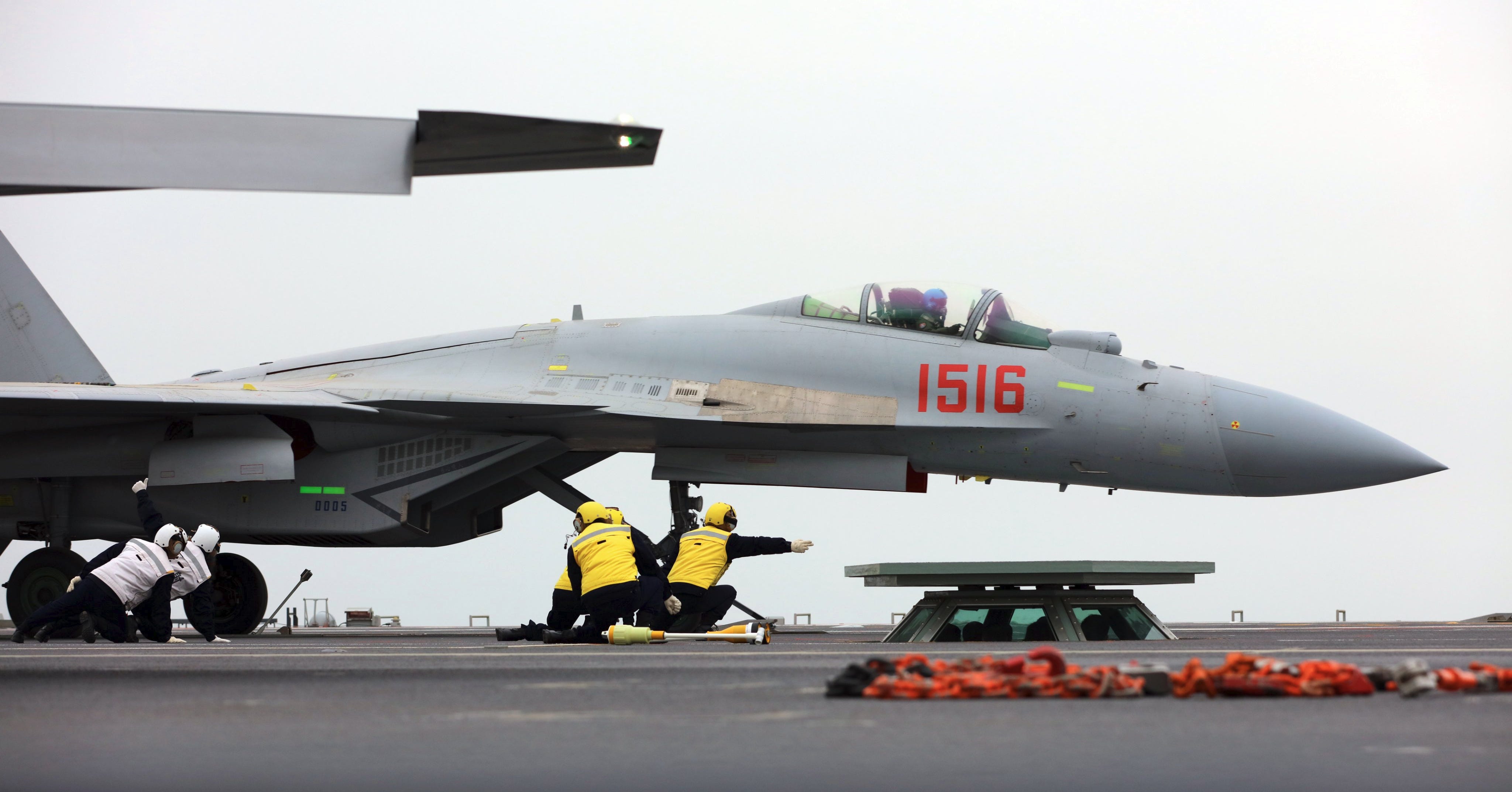
The People’s Liberation Army Navy’s newest and best aircraft carrier launched and recovered the PLAN’s newest and best warplanes in a dramatic demonstration sometime last summer.
As depicted in a lavish PLAN video, the 80,000-ton Fujian—the PLAN’s third flattop, and first purely home-built one—used its electromagnetic catapults to launch a Shenyang J-35 stealth fighter and a Xi’an KJ-600 airborne early warning plane, among other types.
The twin-engine, supersonic J-35 is roughly equivalent to the U.S. Navy’s single-engine, supersonic Lockheed Martin F-35C. The twin-prop KJ-600 is analogous to the USN’s twin-prop Grumman E-2D.
Joined by Shenyang J-15 fighters and J-15D electronic attack jets, J-35s and KJ-600s would round out the PLAN’s air wings—lending them many of the same capabilities the USN’s own wings possess.
It’s unclear how many of the new Chinese types the PLAN’s previous—and much smaller—carriers, Liaoning and Shandong, can also operate. The older flattops lack catapults, and instead launch their J-15s via bow ramps. That method imposes hard limits on the maximum weight of the launching planes.
In any event, China is on the verge of deploying a well-rounded carrier air wing for the first time. What Beijing plans to do with this new capability is obvious. It will project Chinese power deeper into the Pacific Ocean to extend Chinese influence and challenge American influence.
It’s a new problem for the U.S. fleet, which operates 11 carriers including six in the Pacific. For decades, USN planners have primarily worried about defending American flattops—not defeating enemy flattops.
