

by ROBERT BECKHUSEN
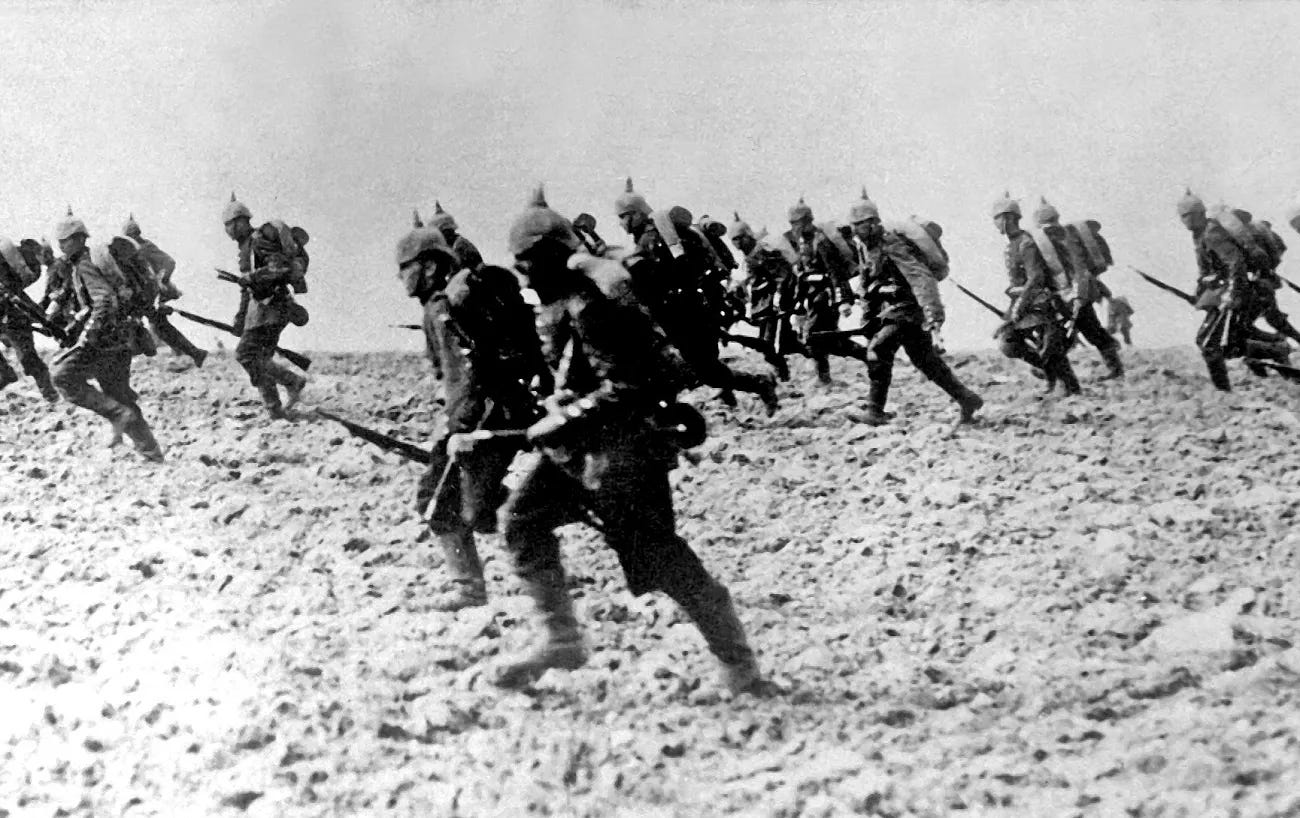
The weather was cold, wet and miserable when 100,000 German soldiers unloaded their rifles, fixed bayonets and charged the French army.
It was a desperate moment. By Sept. 10, 1914, the German armies closer to Paris were largely retreating after a combined Anglo-French offensive during the First Battle of the Marne.
The bayonet charge—one of the biggest of the modern era if not the largest—was the last hope for a German breakthrough before the war settled into a stalemate.
It ended in complete failure.
It’s impossible to imagine the scale of the attack. That it really happened—now a mere historical footnote—is a ghastly reminder of the rapid changes occurring on the battlefield during the early months of World War I.
Europe’s great powers had mobilized mass armies on an industrial scale and sent them into battle with rapid-fire machine guns, but the front lines were fluid and had not yet descended into the mire of blood and mud of the Somme and Verdun.
That would change after the Marne.
But on Sept. 10, Crown Prince Wilhelm, commander of the German Fifth Army, hoped he could still punch a hole in the French lines near Sainte-Menehould. His army was already in trouble—some 5,000 dead and more than 9,000 wounded after 10 days of fighting, according to Holger Herwig’s engrossing 2011 book The Marne, 1914: The Opening of World War I and the Battle That Changed the World.
French artillery opposite the Fifth Army had decimated Wilhelm’s own long-range guns, destroying dozens of them. Wilhelm’s goal was to storm the French positions during the night and put those howitzers out of action.
A successful mass charge days before in another sector convinced him the plan could work.
He failed.
