

by SEBASTIEN ROBLIN
When the 1950s T.V. documentary series Air Power got around to covering the opening battles of World War II, it unfortunately reinforced a popular, and entirely incorrect, notion.
“The Polish air force is caught on the ground,” narrator Walter Cronkite grumbled over images of German bombers pummeling Polish installations. “The Polish air force is destroyed in three days.”
That’s exactly what Nazi propaganda reported after the German conquest of Poland in 1939. But it turns out Nazi propaganda wasn’t entirely honest.
Despite being badly out-classed and out-numbered three-to-one, Polish fighters shot down a large number German aircraft in the chaotic early days of the conflict. Warsaw’s air arm resisted effectively for nearly a week—and, at reduced capacity, continued fighting for more than two weeks.
That’s a Hell of a lot more than three days.
The German Luftwaffe certainly made an effort to destroy Polish aviation on the ground—but the stubborn Poles refused to just roll over.
In 1939, the Polish air force relied entirely on domestically-produced aircraft but devoted just $2 in funding per capita to air power, compared to the $100 per capita Germany allocated.
Conceived primarily to support the army on the ground, the air force had one each independent fighter and bomber brigade and spread out the rest of its aircraft in mixed detachments assigned to ground formations.
There were 445 aircraft in combat units, with additional aircraft in reserve or training units. Not a huge number. But the Polish air arm did boast a strong pilot training program.
In 1939, the German Luftwaffe was unquestionably the most advanced air force the world. The main formations assigned to the invasion of Poland, Luftlotte 1 and 4, counted 1,302 aircraft between them.
The Luftwaffe’s frontline fighter, the Messerschmitt Bf.109, could sprint at 354 miles per hour and was armed with twin 20-millimeter cannons and machine guns. Supporting the Bf.109 was the new, twin-engine Bf.110 fighter-bomber, which could reach a speed of 348 miles per hour and was even more heavily armed than the Bf.109 was, but was a clumsy dogfighter
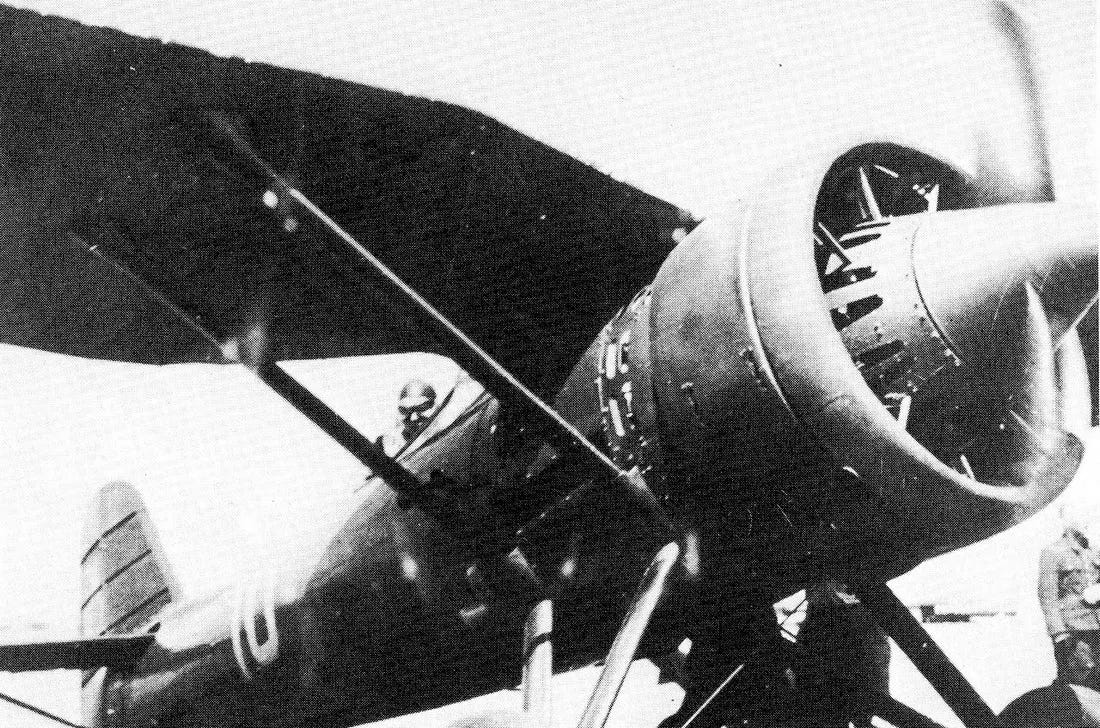
The mainstay of the Polish air force was its 132 gull-wing PZL P.11s, which were state-of-the art monoplanes—in 1931. By 1939, the P.11 was several generations behind. Armed with just two machine guns, the P.11 was more than 100 miles per hour slower than the 109 was.
Warsaw’s air arm also fielded 30 even older P.7 fighters. As war grew imminent, the Poles tried to acquire more-advanced Hawker Hurricane and MS.406 fighters from England and France, respectively—but at the outbreak of conflict, these were awaiting shipment and assembly through Romania, nominally a Polish ally.
The Luftwaffe deployed Ju-87 Stuka dive bombers for ground support. Though slow-moving and vulnerable, Stukas had already earned a reputation in the Spanish Civil War for the terrible howl of their sirens as they executed precision bombing attacks at near-vertical angles.
Finally, two twin-engine medium bombers—the older, pencil-thin Do-17 and the heavy-lifting He-111, famous for its all-glass nose—bombed cities and military installations during the Polish campaign.
The Polish bomber force was not as obsolete as the fighters were. Warsaw’s 120 P.23 Karas strike planes were only slightly inferior to the German Stukas, while the 36 twin-engine P.37 Łos light bombers in the bomber brigade were modern designs capable of attaining 280 miles per hour.
The Polish air force also employed hundreds of light RWD and PWS-26 liaison aircraft to help army commanders communicate and spy on enemy troop movements.
