

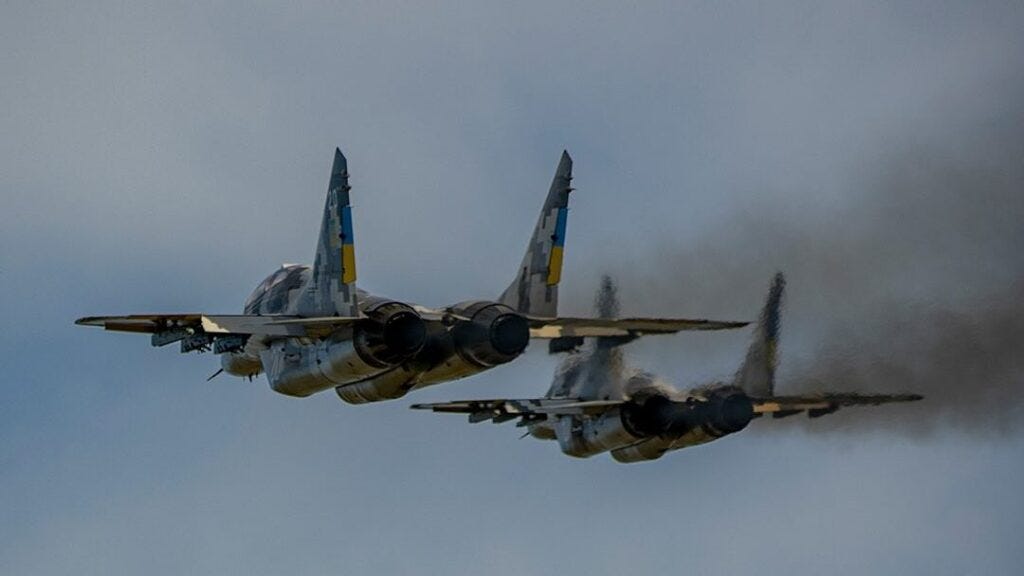
The Jan. 8 strike by a Russian Oreshnik missile targeted the Lviv State Aircraft Repair Plant
The plant repairs the Ukrainian air force’s Mikoyan MiG-29 fighters
There’s no official confirmation of any damage to the sprawling plant
But heavy damage is unlikely—because the Oreshnik is so inaccurate
When Russia launched an Oreshnik ICBM at western Ukraine on Jan. 8, the target wasn’t an underground natural gas storage site near the city of Lviv, as some observers initially believed.
Instead, it was the Lviv State Aircraft Repair Plant. Analysts geolocated the impacts, and the Kremlin later confirmed the target.
The Lviv plant repairs the Ukrainian air force’s Mikoyan MiG-29s—potentially still its most numerous warplanes, and most flexible. The jets have become front-line wrecking balls against Russian offensives, dropping precision bombs on command posts, drone teams, and supply routes from Pokrovsk to Kursk.
Ukrainian officials showed off fragments of the Oreshnik but haven’t yet confirmed or denied Russian claims that the Lviv State Aircraft Repair Plant suffered heavy damage. More than a week after the nighttime Oreshnik strike—the second of Russia’s 47-month wider war on Ukraine—we still don’t know whether the strike achieved anything besides terrifying the residents of Lviv, in western Ukraine 60 km from Poland.
But there are reasons to be optimistic the Lviv plant may soon resume its vital repair work—if it hasn’t already done so. That’s primarily because the Oreshnik, while frightening, isn’t very accurate.
According to missile expert Fabian Hoffmann, the missile’s six individual warheads—each of which includes six separate submunitions—have a “circular error probability” of 200 m. That means the 36 non-explosive munitions packed into an Oreshnik each have a 50% chance of striking within 200 m of their aimpoints.
“The employment of the missile, both in November 2024 when it was first used and in the recent strike, suggests limited projectile accuracy,” Hoffmann wrote. “This is likely because reentry vehicles are not individually guided; instead, they follow a gravity-driven descent after separation from the post-boost vehicle.”
The Oreshnik’s design—it’s apparently a variant of the RS-26 nuclear-tipped ICBM—exacerbates the accuracy problem. Devoid of explosives, the Oreshnik’s submunitions inflict damage through sheer kinetic energy as they slam into the ground at Mach 10.
Where an explosive warhead can scatter fragments over a wide area, a kinetic warhead directs much of its destructive energy downward into the earth instead of outward across the surrounding terrain.
The Oreshnik’s fast-traveling warheads, while visually impressive as they turn into plasma and streak down through the clouds, might not be ideal for taking out a lot of widely spread buildings. “As a result, Oreshnik has very limited utility against most point targets, including individual buildings, air defense sites or enemy launcher assets,” Hoffmann added.
Yes, an Oreshnik “may have some effectiveness against certain area targets, including residential areas that appear to have been struck in the attack a few days ago, as well as larger industrial sites,” Hoffmann conceded.
But Oreshniks would be most effective against an area target when launched in large numbers, Hoffmann explained. “However, given the high cost of each Oreshnik missile, which, while unknown, likely exceeds the price of more common shorter-range ballistic missiles in Russia’s arsenal by a substantial margin, this type of attack would be expensive.”
Red the rest at Euromaidan Press.
New Subscription Prices For 2026

Happy 2026! We’re keeping prices low for annual, monthly, group and gift subscriptions. Subscribe now for daily war new and analysis—and keep Trench Art thriving for another year.