

This story was commissioned by Euromaidan Press. Since Substack pays only around a fifth of my bills, I have no choice but to take on a lot of freelance work. I still want my Substack audience to know where to read those freelance stories, however. Hence this excerpt.
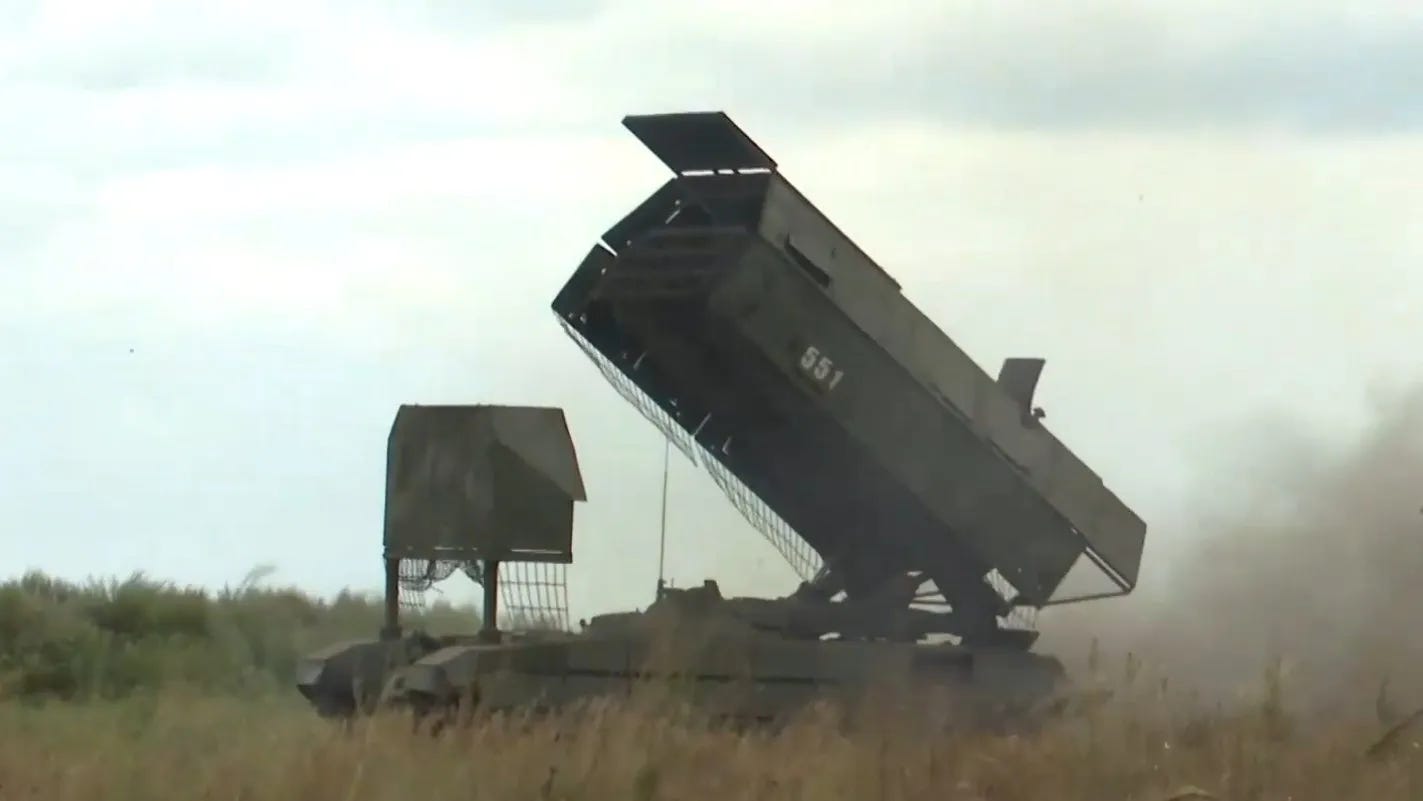
Russia is now building its TOS-1A thermobaric rocket launchers with factory armor wrapped around the rocket tubes. The tracked TOS-1A and its flame-producing 220-mm rockets are a powerful and terrifying weapon. But the launcher is also extremely vulnerable to Ukraine’s drones and artillery. The add-on armor may be the only way the launchers can survive.
The TOS-1A is a T-72 with the turret swapped out for 24 thermobaric rockets, and the newest ones arrive inside a welded steel shell that lifts open when the tubes elevate. Russia is armoring the launcher the way it armors the tanks it’s built from. What happens when the armor fails is not the same.
The TOS-1A adds a 24-round launcher onto the hull of a T-72 tank. The system’s MO.1.01.04M rocket travels as far as 6,000 m with a payload of fuel that, once ignited, burns as hot as 3,000 degrees Celsius. The fuel can spread across the ground and into buildings and bunkers, allowing even a single TOS-1A to scorch a wide area.
It’s not for no reason that the TOS-1A is one of Russia’s preferred siege weapons. TOS-1As rolled into action early in Russia’s wider war on Ukraine. In one of their first actions, in May 2022, TOS-1As staged on hilltops overlooking the city of Lyman, in eastern Ukraine’s Donetsk Oblast, rained fire down on the front-line city. A few days later, Russian troops temporarily occupied Lyman.
The best day the TOS-1A ever had came at Bakhmut. In early April 2023, Russian crews fired across the Bakhmutka River at entrenched Ukrainian positions and opened a 300-m gap in the line, U.S. Army analysts later reconstructed. Wagner mercenaries poured through and covered 1.25 km in a single day.
At Pavlivka, thermobaric fire breached the Ukrainian line and the settlement eventually fell—though it took five months and cost Russia two wrecked naval infantry brigades.
With its origins firmly in the 1970s, the TOS-1A was designed for a different era, however. An era where rocket launchers could, with a little support, safely approach to within a few kilometers of the enemy. Artillery is an ever-present danger, of course. But artillery can be suppressed—usually by other artillery.
The era of relative safety for the TOS-1A ended as tiny explosive drones began filling the sky over Ukraine in 2023. Even the tiniest of these tiny drones has the range to hit a TOS-1A before the TOS-1A can get into position to fire its rockets. Worse, the TOS-1A’s thermobaric rockets are extremely volatile—and tend to explode in massive fireballs when struck.
“Nasty weapons—and also great targets” for anti-tank missiles and other munitions, is how Czech analyst Jakub Janovsky described the TOS-1A in the war’s opening days, before the drones even arrived.
Read the rest at Euromaidan Press.
Help Trench Art Grow To 700 Paid Subscribers

It took a year of hard work, but Trench Art has climbed past 600 paid subscribers! Celebrate with me and keep the momentum going with a 20% discount on paid subscriptions. Just $36 a year for daily war news and analysis.Thanks for reading Trench Art! This post is public so feel free to share it.