

This story was commissioned by Europe’s Edge. Since Substack pays only around a fifth of my bills, I have no choice but to take on a lot of freelance work. I still want my Substack audience to know where to read those freelance stories, however. Hence this excerpt.
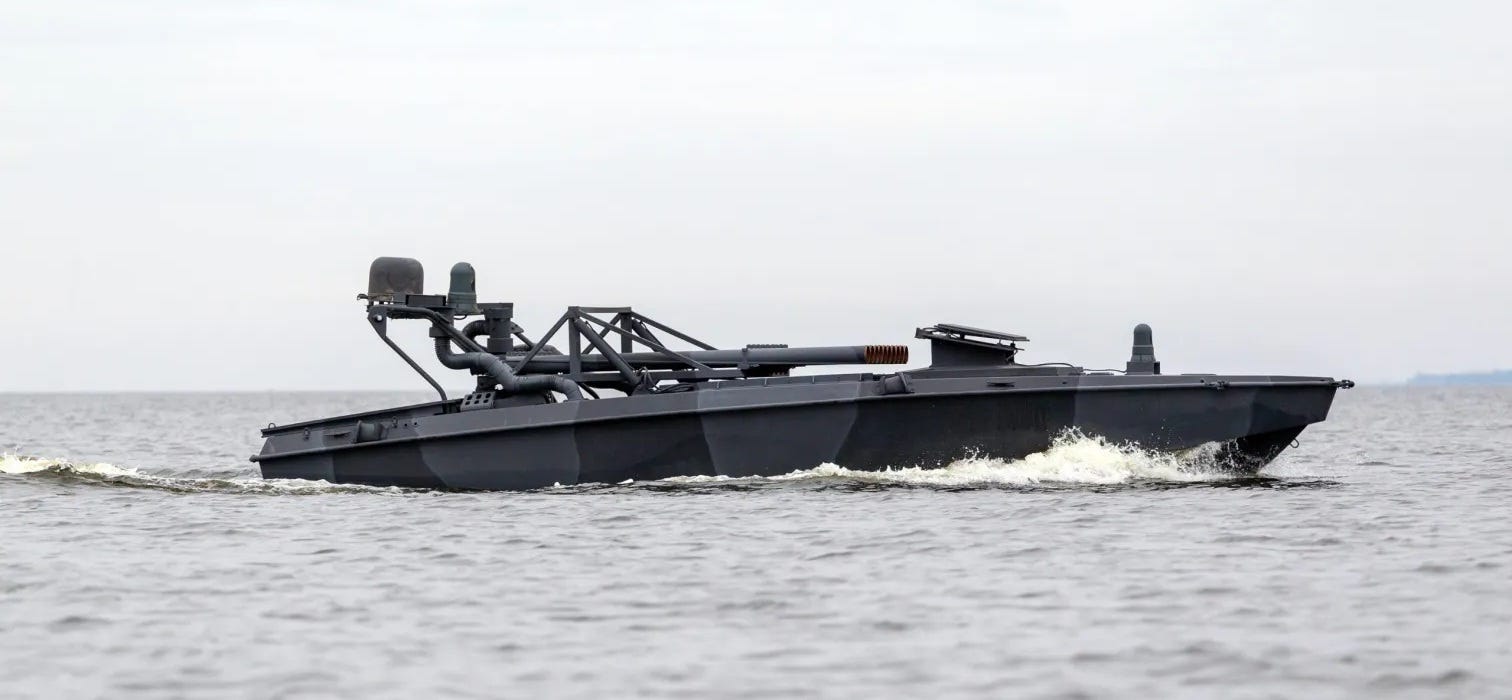
On July 12, three explosives-laden Unmanned Surface Vessels (USVs) motored into an enemy port, maneuvered past whatever defenses may have been in place, and blew up a drydock cradling a submarine undergoing maintenance.
If the USVs had been Ukrainian and the target had been Russian, the robot raid would have been old news.
But the 8-meter (26 ft) Saronic Technologies Corsair USVs belonged to U.S. Central Command. And the target was a naval base in the Iranian port of Bandar Abbas. It was “the first time American forces have employed sea drones in combat operations,” CENTCOM stated.
In the same way, more countries, including the United States, are adopting the Shahed-style one-way aerial attack drones that both Russia and Ukraine fling at each other by the hundreds; more countries are also adopting the kinds of one-way USVs that Ukrainian forces have built their sea denial strategy around.
USVs are cheap and hard-hitting. But they’re no naval panacea. In rushing explosive robot boats into service, countries risk using them the wrong way. For all their many benefits, strike USVs aren’t one-for-one replacements for pricier anti-ship munitions. They’re complementary, not supplementary.
Read the rest at Europe’s Edge.
Independence Day Discount!

Happy 250th birthday to a troubled young country with a rich history and lot of potential. Celebrate July 4th with 25% off an annual subscription to Trench Art, your best source for war news and analysis.Thanks for reading Trench Art! This post is public so feel free to share it.