

by MATTHEW MOSS
In the autumn of 1940, Nazi Germany controlled most of mainland Europe, France had surrendered and the British Army had evacuated the continent—in the process, leaving behind much of its arms and equipment.
To make good losses, the U.K. government ramped-up arms production. Gun-makers updated existing designs such as the Bren light machine gun and the Lee-Enfield Rifle, simplifying them in order to boost production rates.
But officials also considered new small-arms models. Hence the British military’s adoption of the cheap, easy-to-manufacture STEN submachine gun. There were also calls for a simplified light machine gun that armorers could produce in any machine or workshop.
In June 1940, right before the fall of France, the British Ordnance Board had sent out a memo requesting an easy-to-make light machine gun—a contingency in the event that the Germans bombed the Royal Small Arms Factory at Enfield, the United Kingdom’s main machine-gun producer.
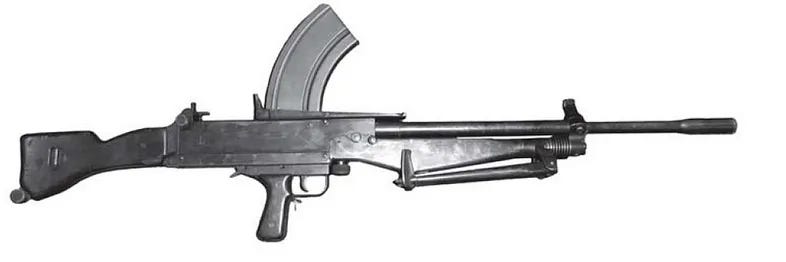
The Birmingham Small Arms company won the contract to develop the design. BSA’s chief designer Henry Faulkner came up with a gun he called the Besal.
The Besal’s production standards were significantly lower than those of the standard Bren. It was truly a last-ditch weapon. Officials intended to issue the new gun if a German invasion were imminent or already underway.
