

This story was commissioned by Euromaidan Press. Since Substack pays only around a fifth of my bills, I have no choice but to take on a lot of freelance work. I still want my Substack audience to know where to read those freelance stories, however. Hence this excerpt.
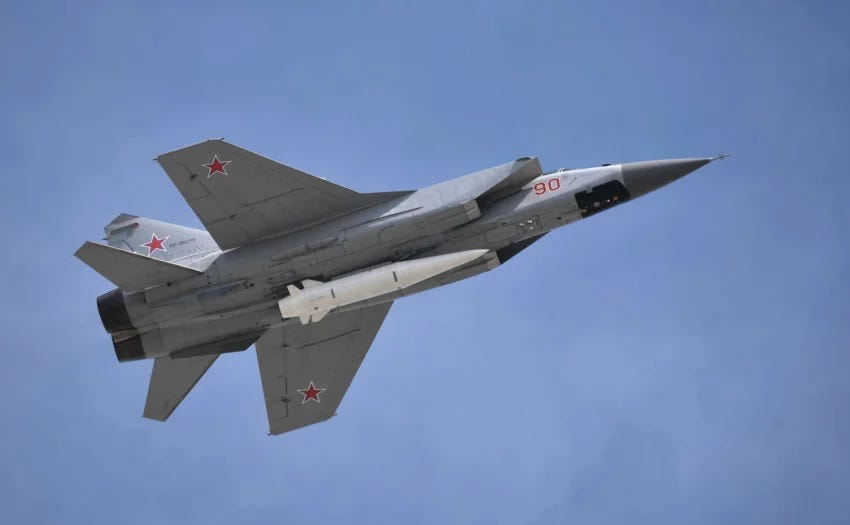
Russia’s Kinzhal air-launched ballistic missile, a version of the ground-launched Iskander, travels as far as 2,000 km at 10 times the speed of sound while packing a 500-kg warhead. It was one of a clutch of purported super-weapons that Russian Pres. Vladimir Putin revealed in a dramatic announcement in 2018.
Launched in mid-air by specially modified Mikoyan MiG-31 interceptors in order to boost its speed and range, the Kinzhal is, in theory, a powerful deep strike munition capable of blasting right through all but the best and rarest air defenses.
In practice, it kept missing. Russia stopped building the $4.5-million missile in April, Maj. Gen. Vadym Skibitskyi, Ukraine’s deputy chief of defense intelligence, told RBC-Ukraine—and the rocket fuel and components that had gone into Kinzhals now go into Iskanders, sea-launched Kalibr cruise missiles and air-launched Kh-101 cruise missiles instead.
The reason is a number. A missile of this class needs to land within five to seven meters of its aim point to be worth firing. The Kinzhal, according to Skibitskyi, lands within 30 meters or more. “We can hardly recall a single instance where this missile hit the target precisely,” he said. Satellite imagery of the Ukrainian air base at Starokostiantyniv, a favorite Kinzhal target, shows the craters ringing the airfield rather than sitting on it.
The Kolomna Machine Building Design Bureau reportedly produced 44 Kinzhals in 2024 and 144 in 2025. The line climbed for two years and then stopped dead.
The Kinzhal isn’t the only munition reportedly getting the ax. The Kremlin is also halting production of the Kh-32 air-launched cruise missile, which Russian engineers repeatedly failed to improve before the program was sent back for further work. “This would explain why Russia has not launched any Kinzhals for multiple months, and very few Kh-32s,” AMK Mapping noted.
At least one analyst anticipated this development years ago. Way back in 2022, Carnegie Endowment analyst Michael Kofman wrote that he didn’t “understand the interest in Russian use of Kinzhal. There’s nothing special or particularly exciting about this system.” It is, according to Kofman, just an Iskander but with a more complicated and expensive launch method.
Read the rest at Euromaidan Press.
Help Trench Art Grow To 700 Paid Subscribers

It took a year of hard work, but Trench Art has climbed past 600 paid subscribers! Celebrate with me and keep the momentum going with a 20% discount on paid subscriptions. Just $36 a year for daily war news and analysis.Thanks for reading Trench Art! This post is public so feel free to share it.