

The Russian army in Ukraine rarely deploys armored vehicles for direct assaults anymore. One pre-emptive Ukrainian drone raid is a healthy reminder why the Russians have mostly held back their armor despite effectively rebuilding the active vehicle inventory following disastrous losses between 2022 and 2024.
Just before June 10, first-person-view drones from the Ukrainian 414th Separate Unmanned Systems Forces Brigade detected the Russian Center Group of Forces staging up-armored MT-LB infantry carriers in a disused coal mine for an apparent planned assault north of the ruins of Myrnohrad in eastern Ukraine’s Donetsk Oblast.
The Russians are trying to push out of Myrnohrad and neighboring Pokrovsk in order to march on the twin free cities of Kramatorsk and Sloviansk, 30 miles to the north.
The Russian vehicles apparently assigned to that assault toward Kramatorsk never left the warehouses where they were stored. “A pre-emptive inspection of the industrial zone at Stakhanov Mine by fiber-optic FPV pilots of the 4th Battalion, 414th Separate USF Brigade ‘Magyar’s Birds’ ensured that nobody would be going anywhere,” wrote Robert Brovdi, commander of Ukraine’s Unmanned Systems Forces.
Deftly maneuvering inside the mine complex, the drones struck at least four MT-LBs and six all-terrain vehicles, setting them ablaze.
The destruction of those 10 vehicles may have deprived an entire infantry company of its rides. “One company of worms was left preparing instead for the one-way ticket hiking route,” Brovdi crowed.
Prefer to walk
Thing is, Russian commanders prefer to attack on foot. Yes, it’s extraordinarily bloody. But the Kremlin is still recruiting 30,000 fresh troops a month: enough to make good front-line losses.
And the Russians have honed infiltration tactics to a fine art, sending lots of small groups of infantry to skirt Ukrainian defenses, day after day until the outnumbered Ukrainians face encirclement and must fall back. Infiltrators stand some chance of slipping past Ukrainian drones; big obvious vehicles stand no chance.
Indeed, as Ukraine’s drone complex expands and patrols deeper across occupied territories, Russian vehicles increasingly struggle to even reach the disputed gray zone, much less attack across it.
The pre-emptive strike on those MT-LBs in the Myrnohrad mine is a reminder “why armor isn’t used anymore,” Jompy observed. “Not because it’s run out, but simply because you can’t use it under the current conditions.”
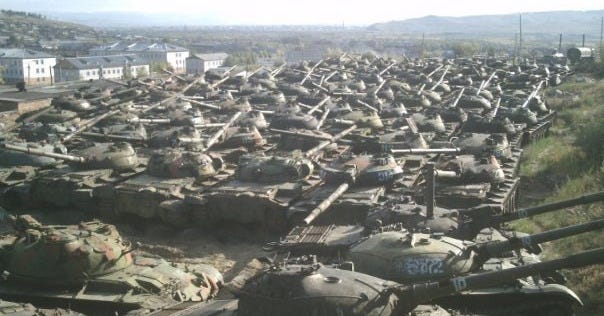
Actually, it has run out, in a sense. Every armored vehicle the Russians lose is a vehicle they can no longer quickly replace. That’s because, to replace the 14,000 armored vehicles they’ve lost in Ukraine since February 2022, the Russians have pulled out of long-term storage practically every usable vehicle.
There were 28,000 Cold War-vintage vehicles in storage in Russian vehicle parks in 2022. Today there are just 12,000. These are “mainly older types such as T-62s, BTR-60/70s, BRDM-2s … all missing parts or outright cannibalized to keep other vehicles running,” according to Jompy. In other words, useless.
Today the Russian armor corps actually has slightly more vehicles than it did before the wider war in Ukraine. But it’s now a single-use force. New production can still replenish combat losses, but at the rate of just 250 new T-90M tanks and a thousand or so other vehicles a year. Far too few to repeat the tremendously costly armor assaults of the first half of the wider war.
And far too few to waste on an assault that never even leaves its base before getting droned.
Help Trench Art Grow To 700 Paid Subscribers

It took a year of hard work, but Trench Art just climbed past 600 paid subscribers! Celebrate with me and keep the momentum going with a 20% discount on paid subscriptions. Just $36 a year for daily war news and analysis.Thanks for reading Trench Art! This post is public so feel free to share it.