

by ELLIOT CARTER
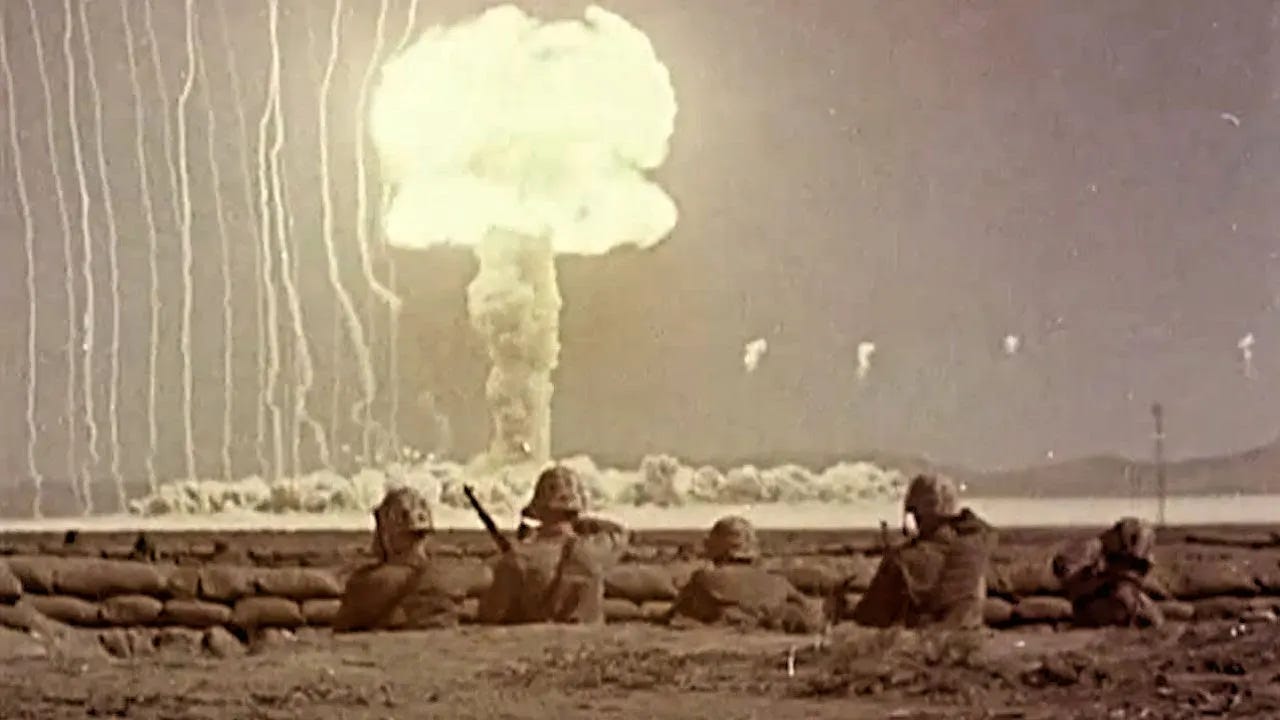
On Sept. 14, 1954, 45,000 soldiers from the Soviet Army’s 270th Rifle Division and other units took shelter in trenches and bunkers as they waited for the order to advance.
The 270th Rifles had fought at Stalingrad in 1942 and at Kursk in ’43. On this day, just north of the Russian-Kazakhstan border, it was about to become the first Soviet formation to train for nuclear war.
Administrators had selected this hilly, forested region of the Orenberg Steppes for the Totskoye atomic test, owing to the area’s topographic similarity to Western Europe, where Moscow planned to wage atomic combat.
Soldiers had been arriving for three months. There was a lot of work to do. Three miles from the planned nuclear epicenter, they built bunkers and pillboxes. Seven miles out, there were the trenches. Planners scattered old tanks and other vehicles across the landscape so they could judge the effects of the atomic blast.
Planners tethered cows, horses and other animals at various distances from the blast site. Along with the soldiers, they were test subjects in the Soviets’ efforts to understand how flesh and blood might respond to nuclear explosions.
And then there were the civilians. “At the time [of the exercise], about a million people lived within 100 miles of the test site,” The New York Times reported in 1993.
These civilians were going to be in for a shock when the 20-kiloton nuclear warhead went off, as the government had failed to notify many of them that this was anything other than a conventional military training exercise.
