

The Pentagon has reportedly warned U.S. Pres. Donald Trump that a second round of intensive air strikes on Iranian nuclear facilities, as well as the inevitable air defense effort once Iran responds, could badly deplete U.S. munitions stockpiles—and make it all but impossible for American forces to wage a major war against China, potentially for years.
It’s not a new problem. The U.S. Air Force has known for many years that it has too few of its best munitions. The war in Ukraine just underscores that uncomfortable truth. Given that Russia and Ukraine both routinely fire hundreds of deep-strike munitions—one-way attack drones, cruise missiles and ballistic missiles—every day, how many days could the Air Force sustain an equally intensive strike campaign?
Not long enough, if a newfound sense of urgency inside the world’s leading air arm is any indication. The Air Force’s budget request for 2026 didn’t include a lot of fighters—just 45—but it did request a lot of air-launched munitions. Nearly $5 billion worth, roughly matching last year’s unusually hefty munitions spend.
It’s obvious why the Air Force wants a lot of missiles and glide bombs, and fast. Even leaving aside the very clear lessons from the first three years of wider war in Ukraine, study after study has come to the same conclusion: a major air campaign could require more stand-off air-to-surface weapons than the Air Force has in its arsenal.
In 2023, the Center for Strategic and International Studies in Washington, D.C. simulated a Chinese invasion of Taiwan in 2026—and a multinational intervention on Taiwan’s behalf led by the United States. “In most scenarios, the United States/Taiwan/Japan defeated a conventional amphibious invasion by China and maintained an autonomous Taiwan,” CSIS analysts Mark Cancian, Matthew Cancian and Eric Heginbotham explained in their summary of the war games.
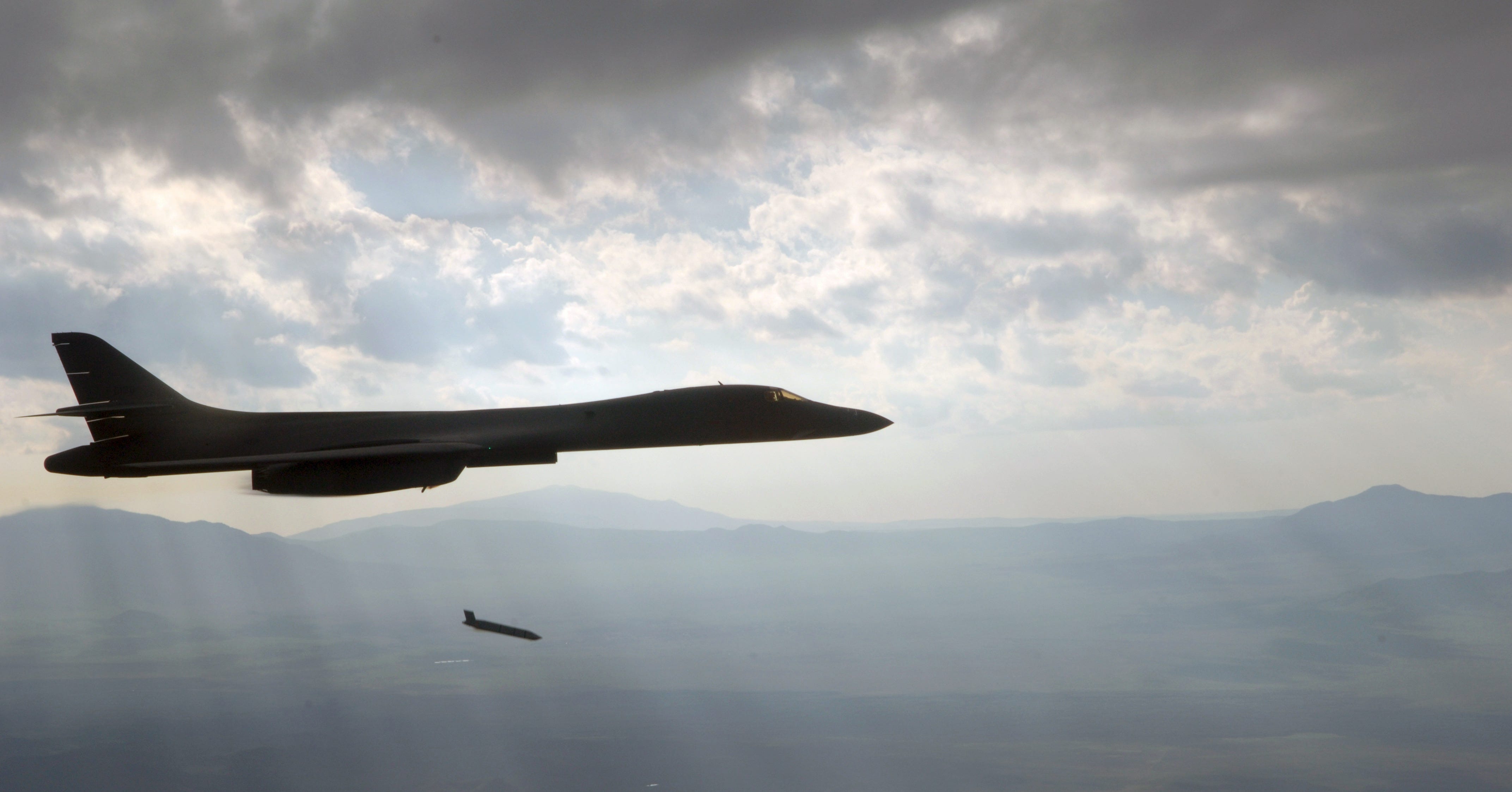
The U.S.-Taiwanese-Japanese alliance won the simulations because it could call on the Air Force’s fleet of roughly 150 long-range bombers flying around-the-clock sorties from the United States with payloads of AGM-158B Joint Air-to-Surface Standoff Missiles–Extended Range, or JASSM-ERs.
A stealthy, subsonic JASSM-ER ranges around 600 miles under GPS and inertial guidance with an infrared seeker and a 1,000-pound warhead. Optimized for strikes on land, the Lockheed Martin-made JASSM-ER may also have an overwater capability—and besides, there’s also an anti-ship variant, the AGM-158C Long Range Anti-Ship Missile, or LRASM.
In the CSIS scenarios, USAF Rockwell B-1Bs, Boeing B-52s and Northrop Grumman B-2s lobbed thousands of precision standoff munitions at the Chinese invasion fleet steaming toward Taiwan. More than 100 Chinese ships sank to the rocky bottom of the Taiwan Strait, dooming the invasion and saving Taiwan.
The bombers are compatible with an array of weapons, but one mattered most in the CSIS simulations. “The JASSM ... is a special case,” the Cancians and Heginbotham wrote. “Its long-range precision guidance and stealthy characteristics make it an important munition for the United States.”
The problem is capacity. To win against China, USAF B-1s and B-52s needed to fire 3,600 JASSM-ERs and LRASMs. That’s roughly how many of the missiles the Air Force has in its inventory today.
There is, in other words, no margin for error. And if U.S. forces had to defend Taiwan while also fighting on another front, they might have too few munitions for one or both conflicts. Thus the rising spending on long-range bombs and missiles even as spending on aircraft—fighters, at least—flatlines for the Air Force.
