

by MATTHEW GAULT
Stephen Klein promised their father he’d see the kids across the wasteland. It’s slow going. His carriage is bumpy, the horse is scared and the landscape is full of death and danger.
Klein doesn’t know what’s wrong with Denise—she bled uncontrollably during church a few days ago. Gauze covers Danny’s head. He’s Denise’s little brother.
The boy was staring at the bomb when it went off. It was the last thing he ever saw. Klein told their father he’d get them to a hospital … or die trying.
“What do you see?” Danny asks Steve.
“Oh,” Klein says. “Cows, telephone poles. The usual stuff.”
The camera pulls back to reveal that there are no cows or telephone poles, just men in masks throwing dead bodies onto the back of a truck. A fine white powder covers everything.
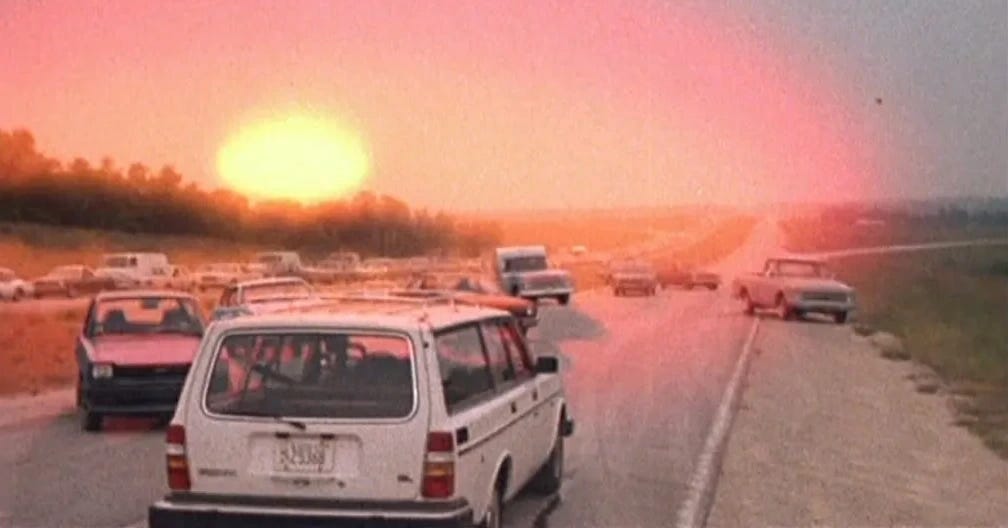
This is Kansas in the 1980s, and America is an irradiated Hellscape. This is The Day After, a T.V. movie ABC aired during primetime in 1983. The film was so effective that it terrified Pres. Ronald Reagan.
He wrote about it in his diary, and some biographers speculated it had a direct effect on Reagan’s desire to end nuclear proliferation during the back half of his presidency.
The Day After is about a world in which the unthinkable happens—the USA and Russia finally launch all their nukes and ruin the world.
The film is set in and around Kansas City, and follows several families and individuals as they struggle to survive in America’s blasted heartland.
Steve Guttenberg plays Klein, a college student who is hitching a ride to see his parents when war breaks out. He joins up with the Dahlbergs, a farming family in Kansas. Jason Robards stars as Russell Oaks, a kindly older doctor who loses his entire family in the opening moments of the war.
ABC spent $7 million to create The Day After, and it’s a rare and wonderful thing—a T.V. movie that doesn’t suck.
Even 43 years later, it still holds up. The filmmakers effectively render the horrors of nuclear war without falling into cliche or melodrama.
