

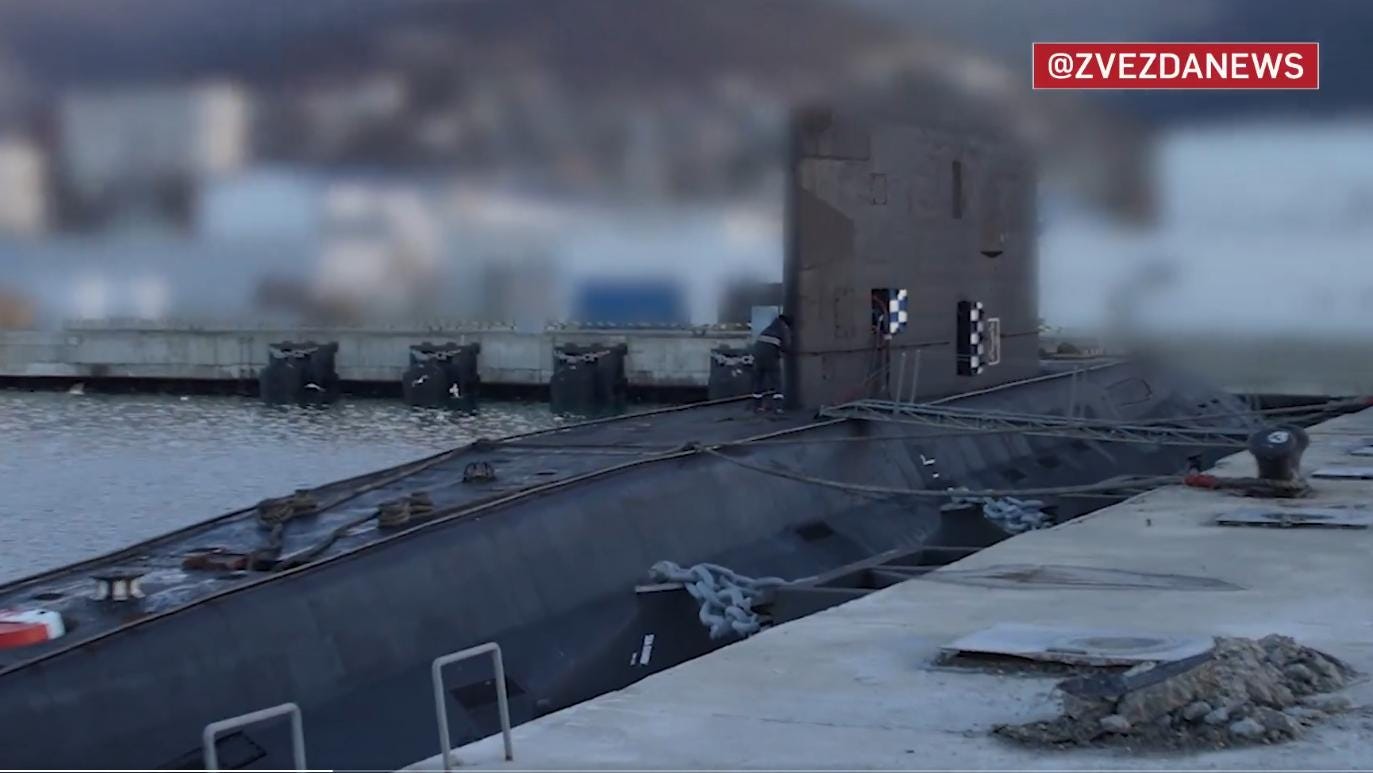
Three days after a drone submarine exploded close by, the Russian submarine Kolpino hasn’t moved from her original moorings
That’s fueling speculation that the sub is damaged—and can’t move
Any major damage is likely under the waterline or inside the sub’s steel hull
It’s unlikely the Russian Black Sea Fleet can safely repair Kolpino, if the sub is damaged
Three days after a Ukrainian drone submarine infiltrated the Russian Black Sea Fleet’s base in Novorossiysk in southern Russia and exploded, the target—the Improved Kilo-class attack submarine B-271 Kolpino—still hasn’t moved from her original moorings, just a few meters from where the Ukrainian Sub Sea Baby drone triggered a warhead weighing potentially hundreds of kilograms.
That’s an ominous sign for the battered Black Sea Fleet, which, after steady losses to Ukrainian missiles and drones, may now have as few as eight warships, including potentially just two Improved Kilos, capable of launching Kalibr cruise missiles at Ukrainian cities.
Many of the other warships inside the protected basin in Novorossiysk as of Monday—including corvettes, frigates, and at least one additional Improved Kilo—quickly departed Novorossiysk in the immediate aftermath of the Ukrainian attack.
But not Kolpino. Satellite imagery from Tuesday and Wednesday confirms: the 74-m diesel-electric submarine was, as of Wednesday afternoon, still moored to the pier where the Ukrainian drone attacked it.
It’s worth asking why. That Kolpino hasn’t budged “allows one to suggest it may not be able to move at this time,” Radio Free Europe reporter Mark Krutov noted. If the sub is indeed immobilized, it may be due to damage sustained to external or internal systems along the vessel’s stern as a result of the shock wave from the massive, and very close by, underwater explosion.
After all, “the most probable threat” to a sub “does not involve direct contact of a ship with a mine” or other underwater munition, “but has the mine exploding in the vicinity of the ship, launching a high-pressure wave into the liquid,” the Massachusetts-based Mitre Corporation explained in a 2007 study.
“During World War II, it was discovered that although such ‘near miss’ explosions do not cause serious hull or superstructure damage, the vibrations associated with the blast nonetheless incapacitated the ship, by knocking out critical components,” Mitre continued.
Read the rest at Euromaidan Press.
