

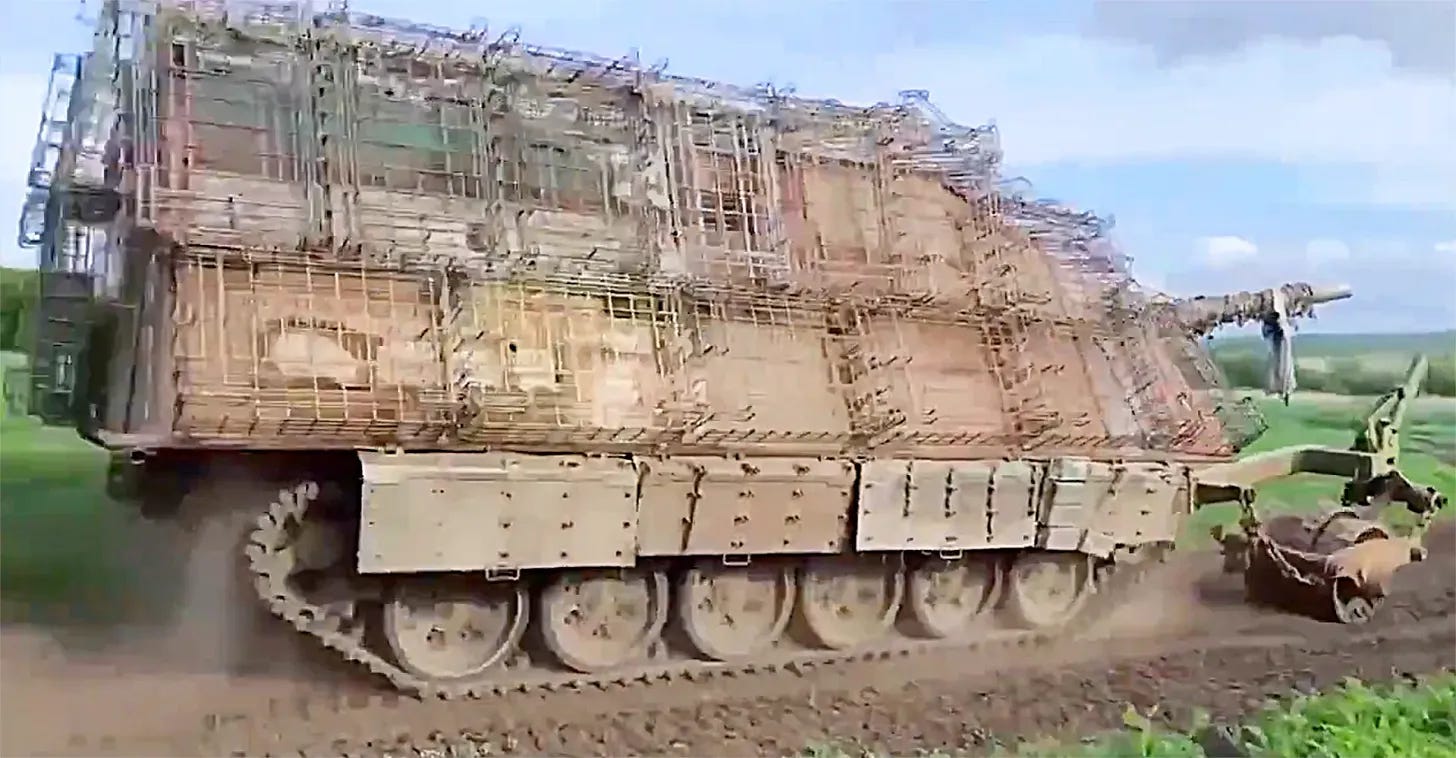
The turtle tank, a massively up-armored tank with layers of protection against tiny explosive drones, is the product of “a constant evolutionary race between protection and firepower that continues on the Ukrainian battlefield,” according to Czech analyst Jakub Janovsky.
Tiny drones are almost sure to be a fixture on any major land war in the coming years and decades. But that doesn’t mean the same conflicts will evolve turtle tanks the way the Ukraine was has done, Janovsky posited. “There are good reasons to believe that turtle tanks will end up being one of those dead-end solutions, one that will soon be surpassed by a far more promising evolutionary adaptation to the drone spam.”
It’s a controversial take—and one well worth reading.
The crux of Janovsky’s argument is that, yes, turtle tanks work. But they don’t work as tanks. Turtle tanks with all the latest add-ons—metal shells, rubber mats, dangling metal chains and metal quills—can withstand as many as 15 hits by first-person-view drones before suffering serious damage, Janovsky wrote. And it might take 50 FPVs to completely destroy a turtle tank. “Which is about two to five times as many as normal tanks usually take.”
But the add-on protection usually impedes a tank’s mobility, partially blinds its crew and prevents the turret from fully rotating, meaning a turtle tank can’t aim its main gun—and can’t fight as a tank.
