

This story was commissioned by Euromaidan Press. Since Substack pays only around a fifth of my bills, I have no choice but to take on a lot of freelance work. I still want my Substack audience to know where to read those freelance stories, however. Hence this excerpt.
by DAVID AXE
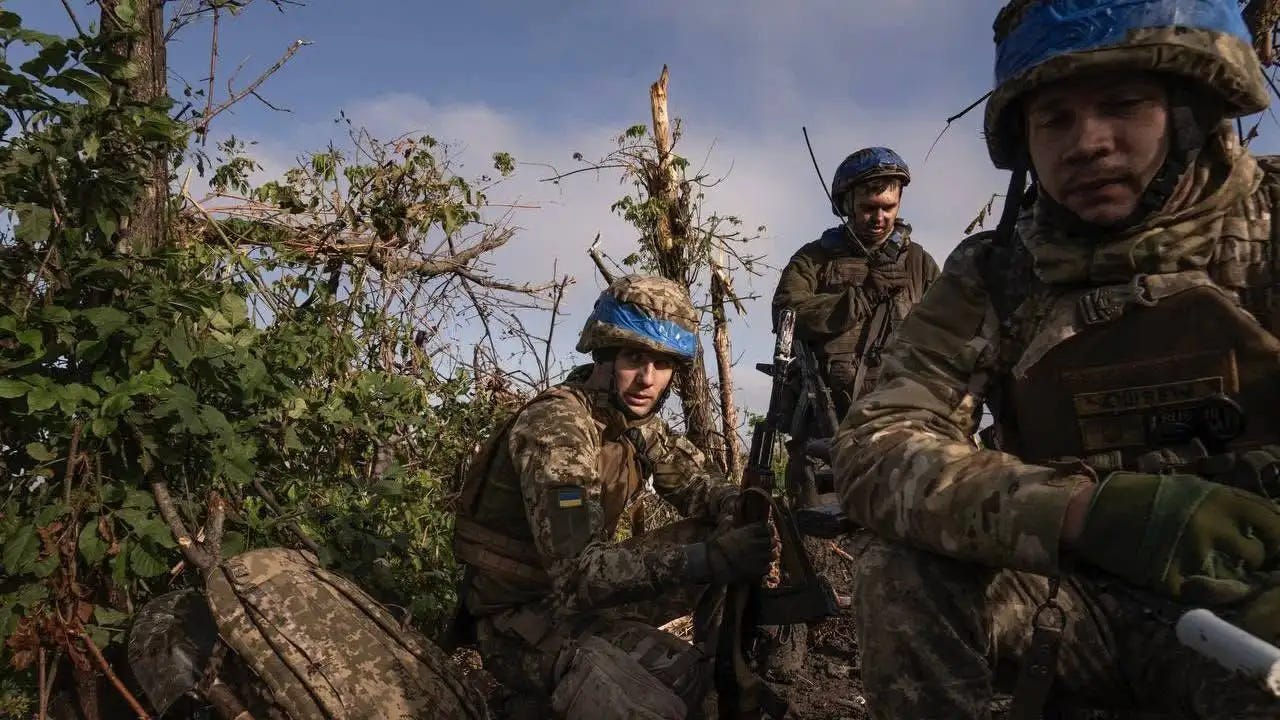
On May 22, a mechanized battalion of Ukraine’s 3rd Assault Brigade—backed by at least two more brigades, the 60th Mechanized and the 66th, attached to the 3rd Army Corps for the operation—attacked Russian positions around the village of Nove, 15 km north of the town of Lyman in eastern Ukraine’s Donetsk Oblast.
Russian drones were heavily jammed that day. Roughly five Ukrainian vehicles were hit, most by fiber-optic drones—the only kind still able to fly.
Nobody outside the Ukrainian army reported it for three months. The first fragmentary accounts surfaced in late August; the full picture early this month. By then the 3rd Army Corps had taken back somewhere between 150 and 240 sq km and wrecked Russian plans for a northern siege of Sloviansk, one of the last two big free cities in Donetsk. Observer Thorkill, writing in Polish, called it a success on an operational scale.
The presence of that Ukrainian armor around Nove, which at the time anchored the right flank of a 100 sq km salient held by regiments of the Russian 20th Combined Arms Army, was an ominous sign for the Russians. After months of careful preparation by the 3rd Army Corps, the Armed Forces of Ukraine (AFU) were strong north of Lyman. Russian forces were weak.
“The moment AFU could start moving vehicles through the area, the battle was basically over,” mapper Vitaly wrote three months later. “Vehicles didn’t win it, they showed up because the conditions that had made vehicle movement impossible were already gone.” Ukrainian drones were everywhere. And Russian drones, effectively jammed by electronic warfare, could barely fly.
Not everyone reads those months the same way. Thorkill, who tracked the sector throughout, puts the breakthrough at Aug. 17 to 18, and writes that for most of July and early August the 3rd Corps’ attacks were repelled by the Russian 144th Motor Rifle Division. On that account the slow months were not a steady advance.
What turned them, he says, is not clear: someone on the Ukrainian side made the difference north of Kolodiazi. He is candid about the limits of what can be seen. Some sources say the Russians withdrew, others deny it, others say they were partly cut off. What he can confirm from satellite imagery is that Ukrainian forces retook Serednie and Zelena Dolyna.
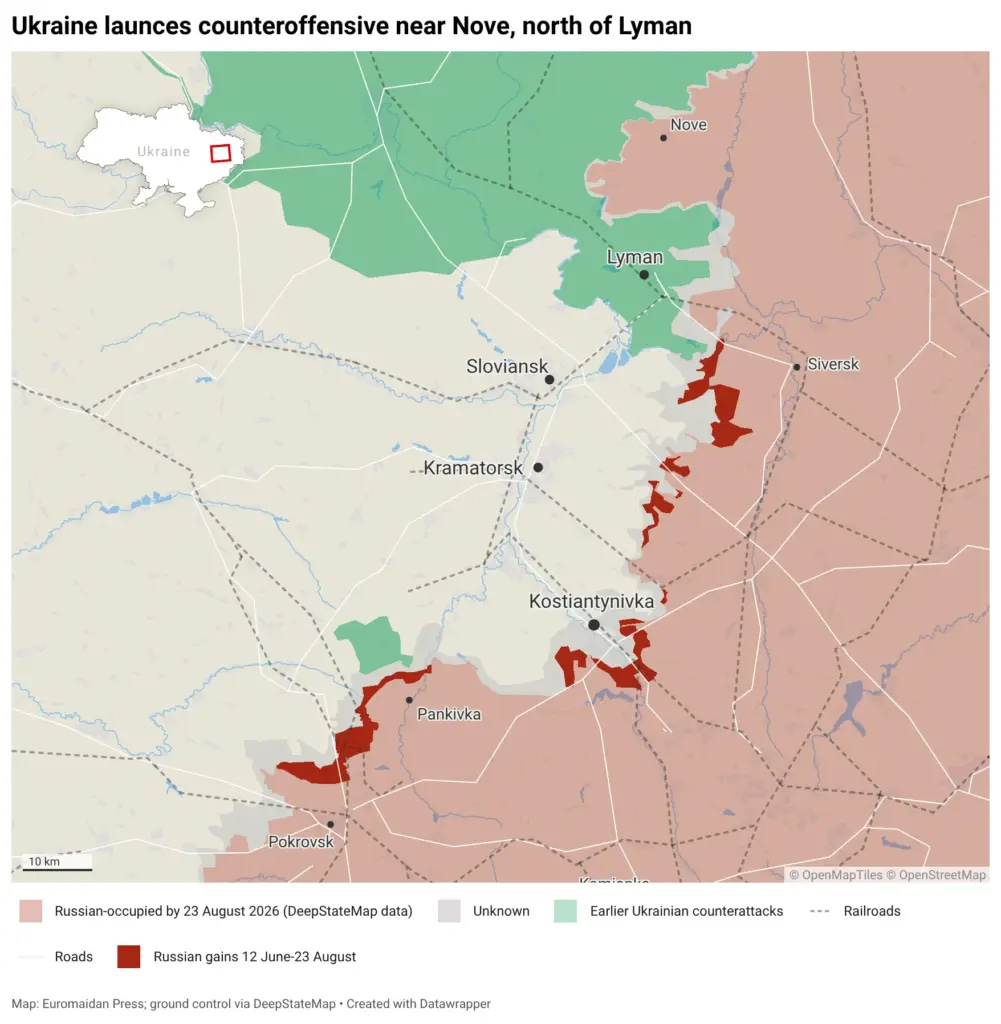
Overextended and pummeled by drones, the Russians barely clung to their salient north of Lyman, which sat between the Nitrius and Zherebets rivers. They were especially exposed at its western edge, where they had pushed across the Nitrius. The Russians had hoped the salient would be a “base for an offensive on Lyman, which could have allowed further offensives to Izium and Sloviansk [and] threatened the northern supply road to Donbas,” according to mapper Clément Molin.
Instead, the salient became a trap as the Ukrainian 3rd Army Corps relentlessly—but quietly—exploited the fragility of the Russian 20th Combined Arms Army. The Russians have now been pushed back toward the Zherebets, leaving behind their uncounted dead ... and their ambitions for a quick northern march on Lyman and then Sloviansk and neighboring Kramatorsk.
It had taken Russian forces 18 months to set the conditions for a push toward Sloviansk from the north. In the three months beginning with that mechanized assault around Nove, the Russians “apparently lost 1.5 years of progress in the area,” Vitaly concluded. Estimates of the ground retaken vary: Molin puts it at more than 200 sq km, the AKM Mapping account at 151, and Konrad Muzyka of Rochan Consulting at around 240.
The appearance of Ukrainian armor around Nove in late May was a strong indication that the 3rd Army Corps had the momentum. But that doesn’t mean the Corps’ eventual victory in the battle for the Lyman salient was a foregone conclusion. On paper, the Russians have a manpower and firepower advantage in Donetsk.
Read the rest at Euromaidan Press.
Help Trench Art Grow To 700 Paid Subscribers

It took a year of hard work, but Trench Art has climbed past 600 paid subscribers! Celebrate with me and keep the momentum going with a 20% discount on paid subscriptions. Just $36 a year for daily war news and analysis.Thanks for reading Trench Art! This post is public so feel free to share it.