

by DAVID AXE
Ukraine’s campaign of so-called “middle strikes” targeting Russian supply lines isn’t generating the same headlines it did back in the spring, when the campaign was intensifying.
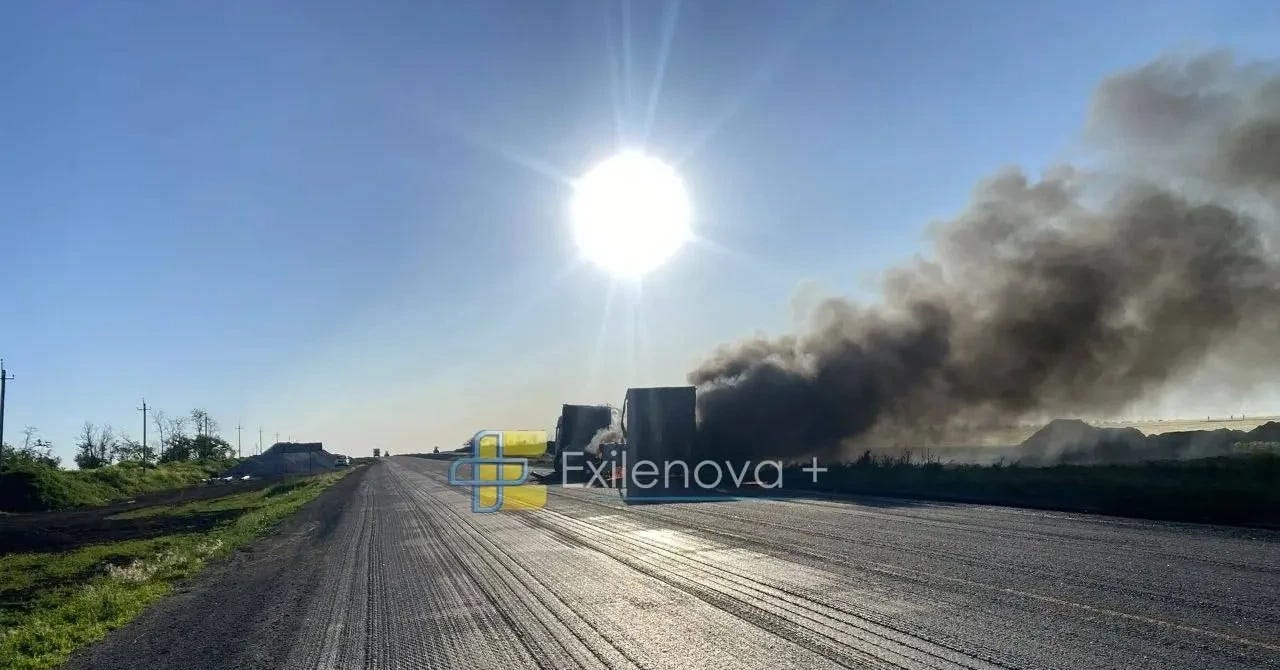
But that doesn’t mean Ukrainian units aren’t launching thousands of drones a month and blowing up a lot of Russian trucks. Indeed, the pace of Ukrainian strikes, concentrated along the main supply routes threading through occupied southern Ukraine into occupied Crimea, has leveled off without ever really decreasing since an early summer surge.
It’s evident Ukraine’s middle-strike campaign “didn’t stop and wasn’t slowed down,” noted French mapper Clément Molin, one of the most important observers of the counterlogistics campaign.
For September, Molin tallied 770 confirmed drone strikes on Russian trucks in the logistical zone 10 km beyond the line of contact. That’s up from 630 strikes in August, 656 in July, and 586 in June, the month the campaign really got underway. There were just 214 strikes in May and at most a few dozen in each of the previous three months.
Whether Ukrainian troops can take advantage of the Russians’ weakening logistics anytime soon is less evident.
Since June, the Ukrainians have hit around 700 Russian trucks a month that analysts can confirm with video and photographic evidence. There are undoubtedly many more damaged and destroyed trucks that left no digital evidence.
There are thousands of Russian trucks on the road in Ukraine every day, so hitting 700 of them in a month won’t immediately strangle Russian logistics. But that accumulating destruction does strain Russian logistics—and terrify the truck drivers who are in the drone crosshairs. “Russian drivers post videos on a daily basis, showing how dangerous a ride in southern Ukraine is getting,” Molin wrote.
What’s remarkable is that the counterlogistics campaign hasn’t faltered even as the Russians have adapted. Early on, Russian trucks mostly traveled alone and without protection, making them fairly easy picking for a bevy of Ukrainian middle-strike drone types including the Hornet, the B-2, the RAM 2X, the Chaklun, and various high-endurance first-person-view quadcopters.
The drones ride along Ukraine’s overlapping command and control systems, which include Starlink satellite terminals (some dangling from balloons) as well as mesh radio networks. Many of the drones have built-in AI for autonomously detecting and homing in on trucks in the final seconds of flight.
Read the rest at Euromaidan Press.
20% Off Paid Subscriptions!

Help keep Trench Art going by taking 20% off a paid subscription! That’s just $36 a year for daily war news and analysis.Trench Art is a reader-supported publication. To receive new posts and support my work, consider becoming a free or paid subscriber.