

by DAVID AXE
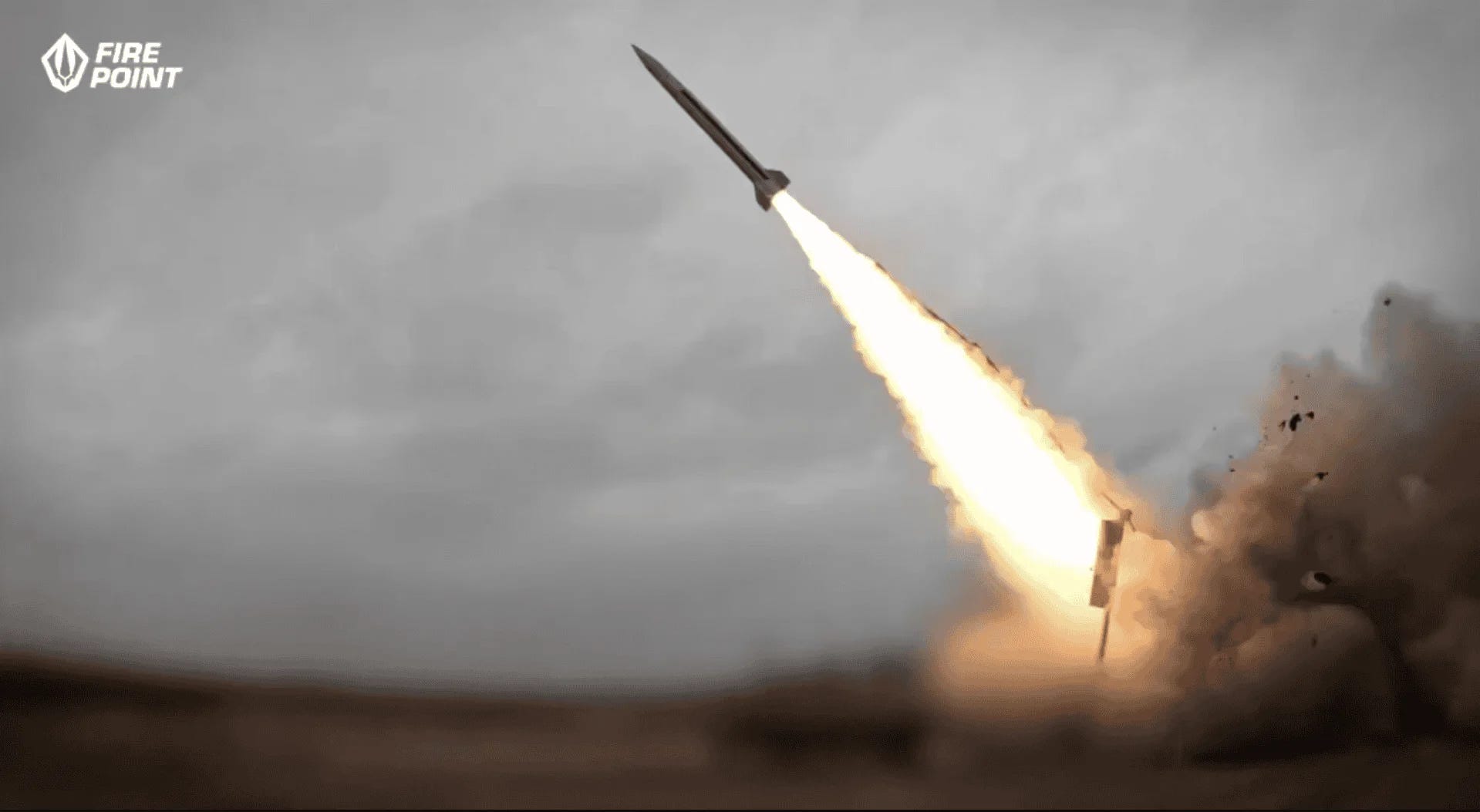
Ukraine has fired its new Fire Point FP-7 ballistic missile in anger for the first time, Ukrainian President Volodymyr Zelensky announced on Thursday.
Kyiv hasn’t said what the missile targeted or how much damage it caused. The Wall Street Journal, citing an unnamed source, reported that it struck a target in Russian-occupied Ukraine. Zelensky was ecstatic on social media. “Thank you for the result,” the Ukrainian president wrote. “Next up: production. Glory to Ukraine!”
The FP-7 can hit back at Russia, but it can’t stop the Iskander ballistic missiles Russia fires at Ukrainian cities. Its twin is meant to. Fire Point is building an interceptor version, the FP-7.X, as the core of Freyja, its bid for a cheaper alternative to the American Patriot, and the company aims for a first ballistic missile interception by mid-2027.
Kyiv drone- and missile-maker Fire Point, most famous for its FP-1 and FP-2 one-way attack drones and FP-5 Flamingo cruise missiles, has been hard at work on ballistic missiles for at least a year. Ballistic missiles can cost millions of dollars per round, making them much more expensive than a $50,000 drone or $500,000 cruise missile.
But the extra expense buys a lot more destructive potential. An FP-1 packs a 60-kg warhead; an FP-7’s warhead weighs about 200 kg. While an FP-1 might motor as far as 1,000 km, it’s slow and fairly easy to shoot down. An FP-7 possesses less range—up to 250 km under the best conditions—but it streaks through the atmosphere at several times the speed of sound, making it extremely difficult to intercept.
The only Russian air defense systems that stand any chance of swatting down an incoming FP-7 are also among the most in-demand in the Russian inventory and thus the most over-stretched: the S-400 surface-to-air missile batteries.
Ukrainians know better than anyone the kind of damage and terror ballistic bombardment can inflict. Since effectively running out of Patriot surface-to-air missiles earlier this year, Ukraine has been unable to defend itself against weekly Russian bombardment that now usually includes several Iskander ballistic missiles.
The Russian bombardment threatens to disrupt commerce, throttle electricity generation and grind down Ukrainian morale at a critical juncture in Russia’s wider war on Ukraine. Ukrainian troops are holding their own along the 1,200-km front line, but behind the front line everyday Ukrainians are suffering under missile and drone impacts.
That suffering will only get worse as winter closes in, temperatures drop and the Russians resume intensive attacks on the electrical grid, potentially depriving millions of people of household heating. Ukrainian batteries firing FP-7s can’t directly prevent Russian attacks. But they can retaliate for the attacks.
Expect the ballistic tit for tat to intensify. It may not be the first Ukrainian ballistic missile fired in anger: in June, Russia said it shot down a Ukrainian ballistic missile over Moscow, and Kyiv never said what it was.
But the FP-7 is the first Kyiv has confirmed using in combat, and it has the range and payload to inflict serious damage on targets inside Russia. But an even more powerful Ukrainian missile, the Fire Point FP-9, is coming soon. It reportedly ranges 850 km with an 800-kg warhead.
Read the rest at Euromaidan Press.
Help Trench Art Grow To 700 Paid Subscribers

It took a year of hard work, but Trench Art has climbed past 600 paid subscribers! Celebrate with me and keep the momentum going with a 20% discount on paid subscriptions. Just $36 a year for daily war news and analysis.Thanks for reading Trench Art! This post is public so feel free to share it.
The War of the Cities Part IV continues.