

by DAVID AXE
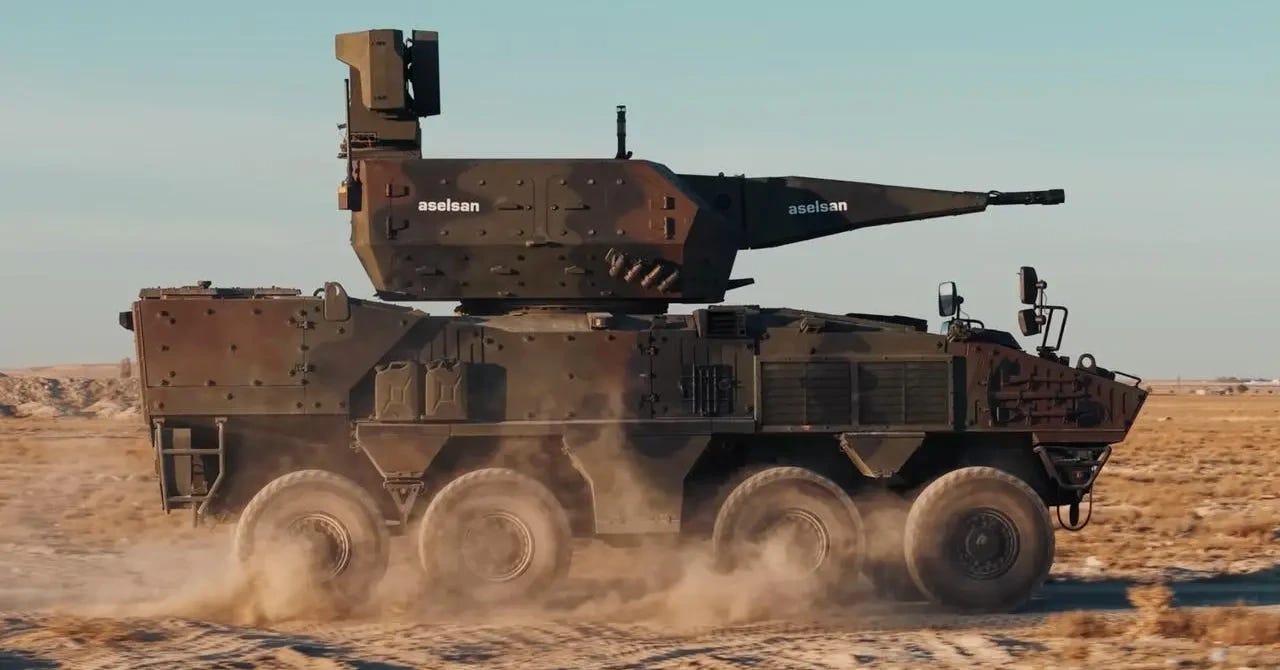
Ukraine has reportedly purchased Korkut self-propelled anti-aircraft guns (SPAAGs) from Türkiye. Effectively a Turkish take on the classic German-made Gepard SPAAG, a mainstay of Ukraine’s defense against Russian one-way attack (OWA) drones, the Korkuts could help stiffen Ukrainian air defenses as winter looms and Russia intensifies its terror attacks on Ukrainian cities and power plants.
The problem for Ukrainian air defenders is that the latest jet-propelled Russian drones, the Geran-4 and Geran-5, are getting through. They fly at around 500 km/h, nearly three times as fast as an older, propeller-driven Geran-2, and in September Ukraine shot down just 55% of them, by Zelenskyy’s count, against at least 90% of the slow ones, one analyst calculated.
The Korkuts arrive in that gap. Ground-based guns are arguably Ukraine’s most cost-effective anti-drone weapons, but they may not work so well against the fastest drones.
That means more Russian munitions are getting through. More Ukrainian homes are burning. More power plants are going dark. It’s a crisis now. It’ll be an even greater crisis when winter arrives and the temperature drops.
All that is to say, the handful of Korkut systems Ukraine has received from Turkish firm Aselsan are welcome, but they’re not silver bullets against Russian drones.
A Korkut battery includes a command vehicle plus three tracked or wheeled vehicles armed with pairs of fast-firing, radar-cued 35-mm autocannons. The exact variant Ukraine received hasn’t been disclosed; Middle East Eye’s mention of 25-mm ammunition suggests it may be the smaller Korkut 100/25, built mainly to stop frontline drones. The Ukrainian Korkuts join a sizeable fleet of SPAAGs in Ukrainian service, most notably including potentially 90 or more 1960s-vintage Gepards with twin radar-cued 35-mm guns.
The tracked Gepards are old but effective. They, like all SPAAGs, can only engage incoming drones and other targets at fairly short range: just a few kilometers. But they’re cheap. A SPAAG might fire a few hundred dollars’ worth of shells to bring down a $50,000 Geran. A surface-to-air missile can hit a Geran from much farther away, but even the cheapest missiles cost tens of thousands of dollars apiece—and the supply is limited.
Gepards and other gun-based air defenses, along with wide-area strategic radio jamming, were the twin keys to Ukraine’s temporary victory over Russian Gerans as recently as late last year. That’s when the Russians were still mostly launching propeller-driven Gerans, and the Ukrainians were shooting down most of them.
Read the rest at Euromaidan Press.
20% Off Paid Subscriptions!

Help keep Trench Art going by taking 20% off a paid subscription! That’s just $36 a year for daily war news and analysis.Trench Art is a reader-supported publication. To receive new posts and support my work, consider becoming a free or paid subscriber.