

This story was commissioned by Euromaidan Press. Since Substack pays only around a fifth of my bills, I have no choice but to take on a lot of freelance work. I still want my Substack audience to know where to read those freelance stories, however. Hence this excerpt.
by DAVID AXE
Russia is launching more of its best jet-propelled attack drones and miniature cruise missiles at Ukrainian ports, cities, warehouses and power plants. The speedy Geran-3, Geran-4, and Geran-5 drones and Banderol missiles can zoom right past Ukraine’s ground-based guns and slower interceptor drones, so the Ukrainian air force is deploying more supersonic fighters to chase down the Russian munitions.
But there’s a problem. The Ukrainian jets are running short of the missiles that work best against them.
A deepening shortage of infrared-guided AIM-9 missiles and radar-guided AIM-120 missiles for the Ukrainian air force’s ex-European Lockheed Martin F-16 fighters has been reported elsewhere. Less well known is what has been happening to the Soviet-era missiles carried by Ukraine’s older Mikoyan MiG-29 fighters.
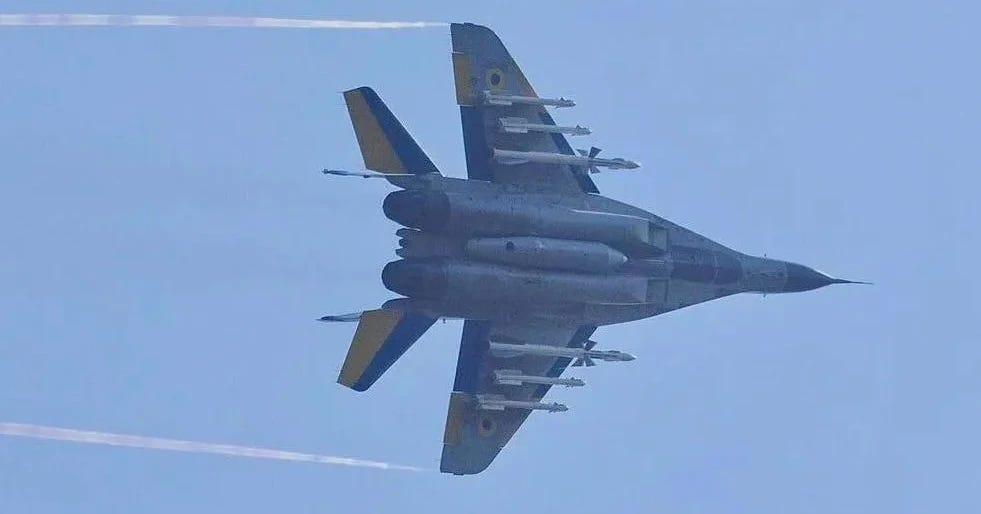
The F-16 is probably the most numerous Ukrainian fighter type, with around 50 in service. But the MiG-29 is a close second. Despite steep losses of MiG-29s in the 55 months since Russia widened its war on Ukraine, Ukrainian aviation brigades may still fly dozens of the classic Soviet-made fighters. MiG-29s are daily sights in the sky over the port of Odesa in southern Ukraine as the twin-engine fighters chase down Russian missiles and drones.
The MiG-29 can carry the full array of Soviet-style air-to-air missiles in the Ukrainian inventory including the infrared-guided R-60 and R-73 and the radar-guided R-27. But the missile of choice for intercepting the 500 km/hr Gerans and 700 km/hr Banderols is the more modern R-73. The $300,000 heat-seeking missile is maneuverable and accurate at the close ranges that are typical of fighter-on-drone engagements.
Ukraine went to war in 2022 with substantial stocks of R-73s and surely received additional copies from allies. While Ukrainian industry built some components for the 1980s-vintage missiles, they were and still are assembled in Russia—so the supply is finite. And the rate of expenditure rose sharply as Ukraine pushed the R-73 onto ground-based launchers and even some robot boats.
Read the rest at Euromaidan Press.
Help Trench Art Grow To 700 Paid Subscribers

It took a year of hard work, but Trench Art has climbed past 600 paid subscribers! Celebrate with me and keep the momentum going with a 20% discount on paid subscriptions. Just $36 a year for daily war news and analysis.Thanks for reading Trench Art! This post is public so feel free to share it.