

This story was commissioned by Euromaidan Press. Since Substack pays only around a fifth of my bills, I have no choice but to take on a lot of freelance work. I still want my Substack audience to know where to read those freelance stories, however. Hence this excerpt.
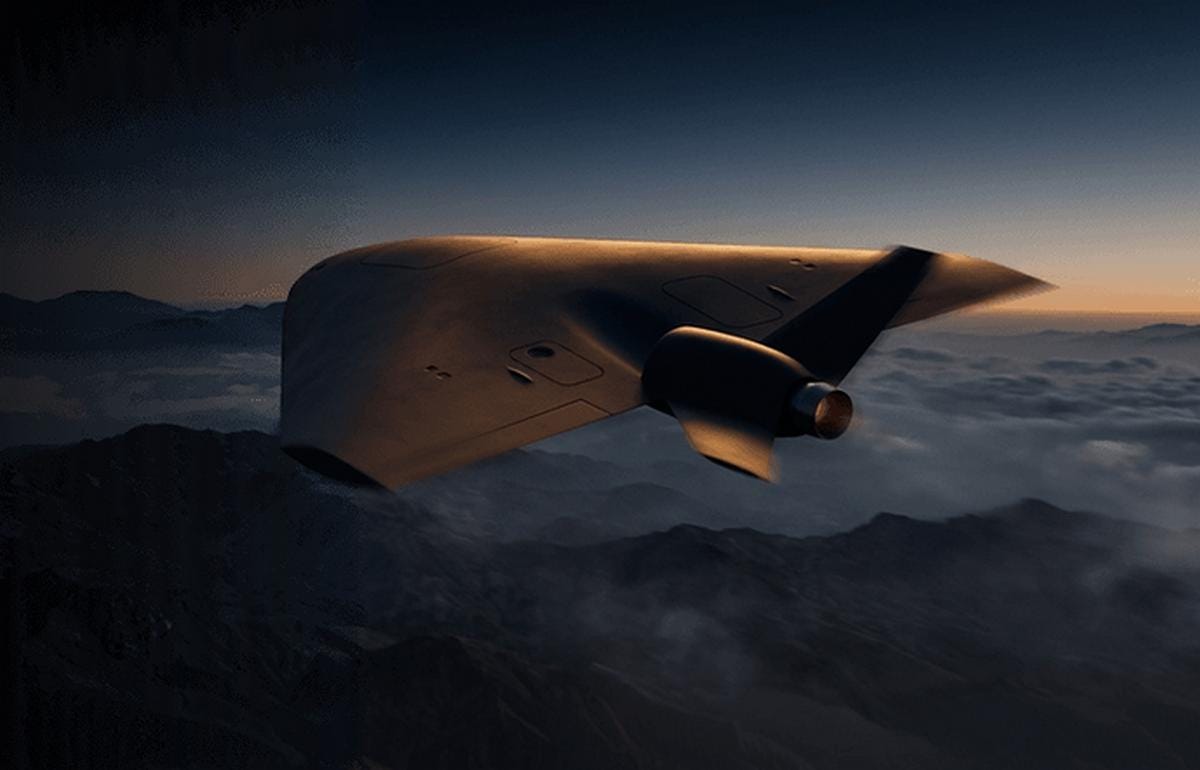
Ukraine’s latest deep strike drone is one of a kind. The Triada Robotics Bravo features a “blended wing body” design that’s rarely seen on a drone. The special platform maximizes lift and minimizes drag, helping the drone fly farther for a given speed and payload than a conventional “tube and wing” drone can do.
A stubby jet drone appeared fleetingly in a video shot from the ground during a strike on the Ufa refinery cluster in Bashkortostan on Aug. 2, more than 1,700 km from the Ukrainian border. Ukrainian forces hit the three Bashneft plants at Ufa on Aug. 1, 2 and 5.
No official body has identified the aircraft in the footage. Online observers compared the silhouette to the American Lockheed Martin F-117; the outline is also consistent with the renders Triada publishes of the Bravo. The clip runs a few tenths of a second.
Everything that has reached that deep into Russia until now has been propeller-driven, plodding along at less than 200 km/hr. A jet Bravo cruising at 600 km/hr covers the same 1,700 km in under three hours instead of nine and a half. That is the difference between an air defense network with all morning to work out where a drone is going and one with a couple of hours.
Exactly what the drone in the video was aiming for, and whether it struck its target, is unclear. But that’s not stopping Russian observers from panicking. “Shooting down a drone is practically impossible,” one Russian blogger moaned.
It’s untrue. The jet-propelled Bravo is neither the fastest Ukrainian deep strike munition nor the slowest. If Russian air defenses can take down 950 km/hr Fire Point FP-5 Flamingo cruise missiles, they can take down Bravos, too. Detecting one is a separate question: Triada says the Bravo’s composite airframe reduces its radar cross-section.
But invulnerability surely wasn’t the main goal when Kyiv-based Triada Robotics designed the Bravo over the past couple of years. Efficiency was the objective. Which is probably why the firm chose the blended-wing-body arrangement for the one-way explosive drone, which it lists at around 174,000 euros—roughly $200,000.
The blended shape “provides many different aerodynamic benefits over conventional aircraft design,” Oliver Johnson and Sam Dakka wrote in a 2019 article in International Journal of Aviation, Aeronautics and Aerospace.
Most drones, like most manned aircraft, have the same layout: a tube-shaped body and separate wings jutting from the body. These tube-and-wing aircraft are the easiest to conceptualize and the most straightforward to assemble, as the fuselage and wing can be built independently and attached during production.
The problem is drag, especially at the junctures between body and wing. A draggier airframe suffers a range and speed penalty compared to a less draggy airframe.
Read the rest at Euromaidan Press.
Help Trench Art Grow To 700 Paid Subscribers

It took a year of hard work, but Trench Art has climbed past 600 paid subscribers! Celebrate with me and keep the momentum going with a 20% discount on paid subscriptions. Just $36 a year for daily war news and analysis.Thanks for reading Trench Art! This post is public so feel free to share it.
Fingers crossed the speed increase makes Russia use their SAM interceptors. Depending on how many sites they have and how low this drone can fly, Ukraine may be able to shotgun these on different paths, identify SAM launch sites and radars and hit those.