

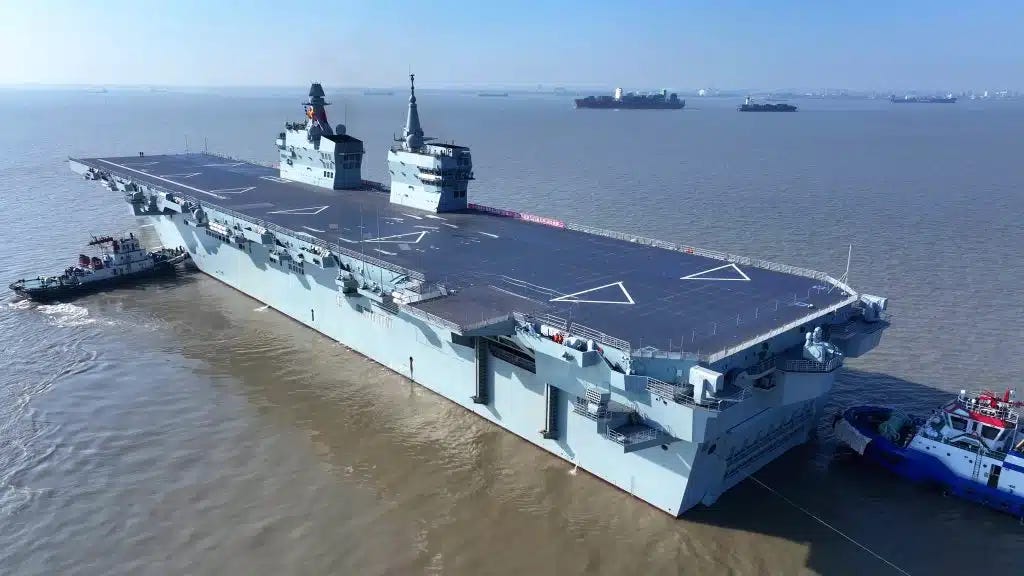
It was more apparent than ever, as the Chinese navy’s first-in-class Type 076 assault carrier undertook sea trials in November, that the 44,000-ton vessel is, among other things, a drone carrier.
Sichuan has two islands—one for navigation, another for air control—as well as the elevators and catapult one would expect from an aircraft carrier. But she doesn’t have an angled deck for aborting aircraft: standard on carriers with manned aircraft since the 1950s.
If China operated vertical-landing manned aircraft—a.k.a., jump jets—the Type 076 might be an assault ship in the category of the U.S. Navy’s America- and Wasp-class vessels: primarily an amphibious vessel but with significant aviation capability in the form of rotorcraft and jump jets.
But China doesn’t operate jump jets. The natural conclusion, then, is that the Type 076 is meant to embark an air wing with a large contingent of fixed-wing drones. Potentially including heavy jet-propelled ones in the class of the Hongdu GJ-11 with its 47-foot wingspan.
The Type 076 isn’t alone, of course. China is experimenting with at least one other drone carrier. And Turkey is developing one, too. The Royal Navy plans to integrate drones with the Lockheed Martin F-35s and AugustaWestland AW101s currently flying from HMS Queen Elizabeth and HMS Prince of Wales. The U.S. Navy’s Boeing MQ-25 tanker drone is set to fly from a flattop as early as next year.
Drone carriers and carriers with hybrid manned-unmanned air wings are all the rage. But hard experience in Ukraine, and the perils of a possible major war in the western Pacific Ocean, raise difficult questions. Is it wise to concentrate long-range drones on exquisite and highly vulnerable platforms, when drones lend themselves to dispersed operations?
Considering the question from the U.S. and allied perspective is illuminating. Perhaps the Chinese navy has worked out a use case for drone carriers. The plan may be for a battle group anchored by a Type 076 to encircle Taiwan from the east: a front in a possible Chinese invasion of Taiwan that’s largely inaccessible to land-based Chinese air power.
Regardless, it’s much harder to justify drone carriers for the U.S. and allied fleets.
Lacking on-board crew, largely runway-independent and capable of autonomous or partially autonomous flight, the latest long-range drones beg to fly from many crude bases and platforms on land and at sea rather than from a few very exquisite platforms at sea. To say nothing of flying from the sprawling air bases to which manned aircraft are largely tethered.
Read the rest in Combat Aircraft.
20% Off Annual Subs For Valentine's Day!

Make love not war this month at Trench Art. We’re cutting the price of an annual subscription by 20% through Valentine’s Day. Subscribe now for daily war new and analysis.
I have followed you for years. This is too much. If you are going to bait and switch, I will cancel. Sorry.
06 Feb 26. Here we go again: WHY, when we pay good money to subscribe to your basic blog, David Axe, do we keep encountering items you PARTLY post there...but when we go to the link at some other Web site, THAT outfit won't let us read the rest of that same article unless we subscribe to THEM??! Kind of sucks.